Best DDoS Protection for Minecraft in Russia 2026
If you run a Minecraft server targeting players in Russia and the CIS region, DDoS protection requires a different approach than what works for Western audiences. Attacks on game servers in 2026 are cheaper, more powerful, and more sophisticated. Meanwhile, the choice of solutions for the Russian market is far from obvious. International CDNs often add latency, while local providers do not always handle the volume.
This article compares different approaches to Minecraft server DDoS protection, evaluates them against key criteria, and helps you pick the right solution for your situation.
Why Minecraft Protection Is a Separate Problem
Minecraft runs over TCP (Java Edition) or UDP (Bedrock Edition). The protocol is well-documented, attack tools are publicly available, and motivations range from server competition to extortion. Common attacks include SYN floods, bot-join floods (thousands of bots mimicking real player connections), protocol-level floods (status ping, handshake, login start), and pure volumetric attacks designed to saturate bandwidth.
A standard web WAF does not understand the Minecraft protocol. Cloudflare Spectrum can proxy TCP traffic but does not inspect packet contents at the game protocol level. Effective protection requires a solution that parses Minecraft packets and distinguishes bots from real players.
Comparison Criteria
Latency
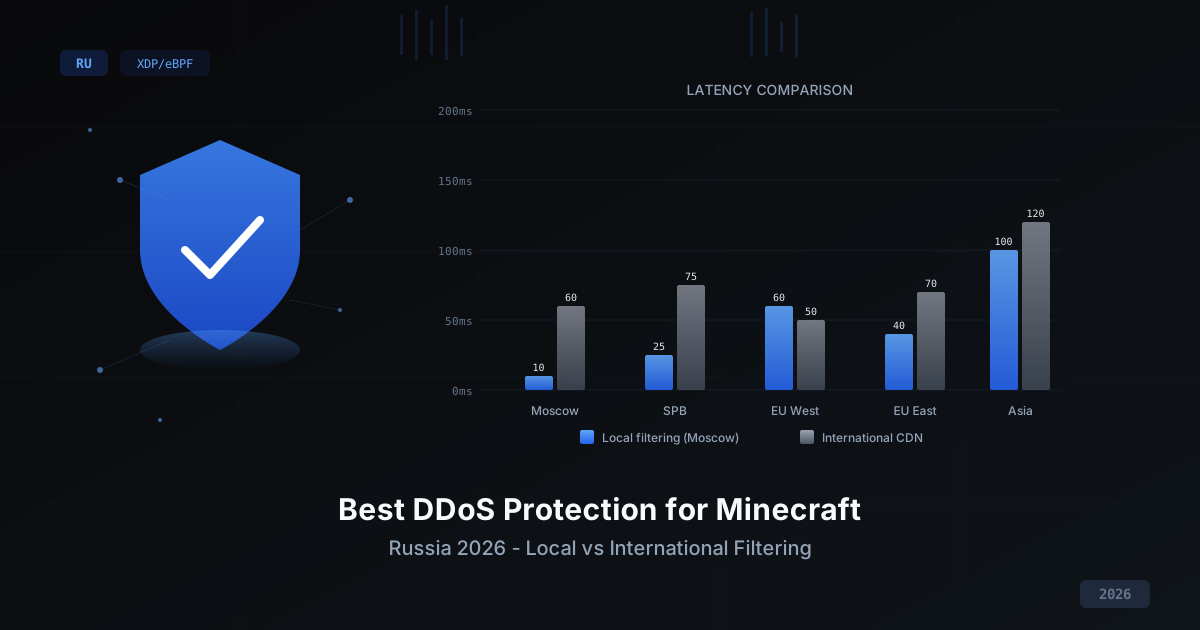
For most web applications, the difference between 20ms and 80ms is invisible. For Minecraft, it changes the game. Every packet between client and server passes through the filter. If the filter adds 50ms, PvP becomes uncomfortable above 80-100ms total - hit registration lags, knockback breaks, combos fail. For PvP-focused servers (HCF, Practice, KitPvP), this is a dealbreaker.
If your audience is mostly in Moscow and central Russia, a filter in Frankfurt adds 40-60ms. A filter in Moscow adds 5-15ms. The difference is significant.
Filtering Capacity
How much attack traffic can the solution handle. Measured in Gbps for volumetric attacks and Mpps for packet-rate attacks. In 2026, attacks on game servers regularly reach 50-200 Gbps. A solution capped at 10 Gbps cannot handle serious threats.
Protocol Analysis Depth
Three levels exist: L3/L4 filtering (IP and TCP/UDP headers only), protocol-level filtering (Minecraft packet validation, handshake/login rate limiting), and behavioral analysis (connection pattern tracking, bot detection via packet timing, cookie verification). Deeper analysis stops smarter attacks but requires more resources.
Price and Support
Costs range from free to hundreds of dollars per month. For Russian-speaking admins, having support in Russian matters - explaining a critical issue through Google Translate during an active attack is not ideal.
Approach 1: International CDN Providers
Companies like Cloudflare, Akamai, and AWS Shield offer massive global networks and huge filtering capacity. Cloudflare claims over 300 Tbps of total network bandwidth.
Pros: Enormous capacity, global presence, Cloudflare Spectrum can proxy Minecraft TCP traffic.
Cons: Latency for Russia (nearest PoPs for Spectrum traffic are often Helsinki or Frankfurt, adding 30-60ms for Moscow players), no Minecraft protocol analysis, English-only support on lower tiers, pricing starts at $20/month for Spectrum with limited bandwidth.
For Minecraft servers with Russian audiences, international CDNs are a compromise - great for volumetric attacks, but they add noticeable latency and miss protocol-level threats.
Approach 2: Self-Hosted Solutions
Setting up protection on your own server using iptables/nftables, fail2ban, sysctl tuning, and possibly BungeeCord/Velocity as a proxy.
Pros: Full control, zero cost (aside from your time), no added latency.
Cons: Limited capacity (typical VPS has 1-10 Gbps), no volumetric protection (if the attack saturates your upstream link, firewall rules are irrelevant), requires expertise, no external support.
Self-hosted works as a supplement to primary protection. Basic iptables + sysctl tuning is a mandatory baseline for any server, but it is not enough as the sole defense for servers with real audiences.
Approach 3: Specialized Local Filtering
Services that specialize in game server protection with filtering points in the target region. Traffic passes through a nearby filter before reaching the actual server.
Pros: Minimal latency (1-5ms if the filter is in Moscow and your audience is in Russia), deep Minecraft protocol analysis, game-traffic-specific rules, Russian-language support.
Cons: Smaller capacity compared to global CDNs (typically 100-500 Gbps, but sufficient for 99% of Minecraft attacks), single-region optimization.
Approach 4: Free Solutions
Free options typically offer basic L3/L4 filtering, limited capacity (10-20 Gbps), shared IP addresses, and minimal support. They work for small hobby servers under 30-50 players that are not regularly targeted. For commercial servers, relying solely on free protection is risky.
Why XDP/eBPF Filtering Matters
Not all solutions filter traffic the same way. Traditional userspace filtering copies each packet through the kernel stack into user space for analysis. At high packet rates (10+ Mpps), this becomes a bottleneck.
XDP (eXpress Data Path) and eBPF process packets at the earliest possible point - before the kernel creates sk_buff structures. The result: a single CPU core can filter 10-20 Mpps, added latency is measured in microseconds rather than milliseconds, and CPU usage stays minimal.
This is not marketing - XDP/eBPF is used in production by Cloudflare, Meta, and Netflix. For game servers, the key advantage is near-zero added latency with high filtering throughput.
Why Moscow as a Filtering Location Matters
Most Russian Minecraft players are concentrated in the European part of Russia. Ping through a Moscow filter: 1-5ms from Moscow, 10-20ms from Saint Petersburg, 25-35ms from Yekaterinburg. Through a Frankfurt filter: 35-55ms from Moscow, 30-45ms from Saint Petersburg, 55-70ms from Yekaterinburg.
A 30-40ms difference is significant for PvP. A player at 15ms has a noticeable advantage over one at 55ms in close combat. If your server focuses on PvP, low ping is a competitive advantage that retains players.
The ideal setup for mixed audiences: Moscow filtering for Russian players and a European point for international traffic.
Selection Algorithm
- Small hobby server (under 20 players, rare attacks) - free protection + basic iptables
- Medium server (20-100 players, periodic attacks) - specialized local filtering
- Large project (100+ players, commercial, regular attacks) - local filtering with high capacity + self-hosted hardening as a second layer
Before purchasing, verify: actual latency the filter adds (request a test IP), real filtering capacity (not marketing numbers), Minecraft protocol support, bot-join protection, support response time, and SLA guarantees.
Common Mistakes
- Choosing based on marketing numbers ("up to 10 Tbps" is shared across thousands of clients)
- Ignoring latency (players leave for lower-ping servers even if your content is better)
- Skimping on protection for a monetized server (one hour of downtime costs more than a month of protection)
- Having a single point of failure (plan for filter failover)
- No server-side hardening (external filtering plus sysctl/iptables tuning - defense should be layered)
Conclusion
The best Minecraft DDoS protection is the one that matches your server profile. For small servers, free solutions work. For medium ones, specialized filtering with a local presence point. For large projects, combine local filtering, CDN for international traffic, and self-hosted hardening as the last line of defense.
Key takeaways: latency is critical for PvP, XDP/eBPF provides minimal latency at high throughput, Minecraft protocol analysis is mandatory for bot-join protection, Moscow filtering gives a tangible advantage for Russian audiences, and defense should always be layered.
Protect Your Server from DDoS Attacks
Free protection with 5-minute setup. 1 TB bandwidth included.
Try for FreeRelated Articles

TCP vs UDP Attacks on Minecraft Servers: Breaking Down the Differences
Minecraft Java runs on TCP, Bedrock on UDP. Attacks on these protocols differ fundamentally: SYN floods vs amplification, stateful filtering vs DPI. We break down each attack type, real traffic volumes, and defense strategies.
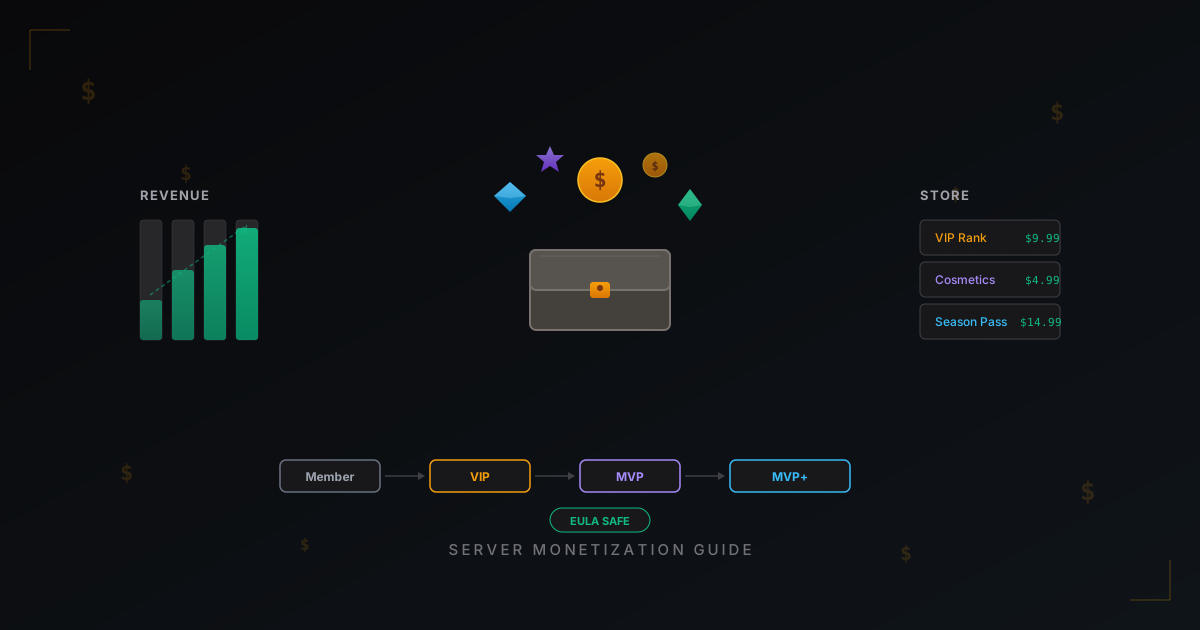
How to Monetize a Minecraft Server: Donations, Ranks, Stores & EULA
Complete guide to earning money from your Minecraft server without breaking the Mojang EULA. Monetization models, donation plugins, pricing strategies, and real revenue numbers.
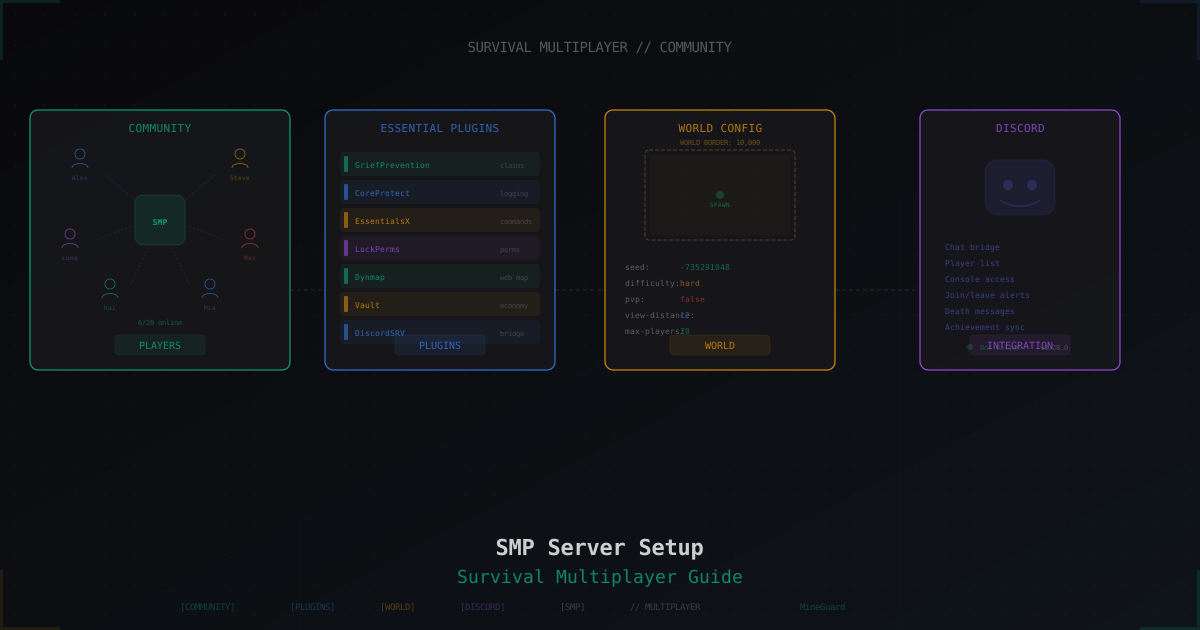
Minecraft SMP Server in 2026 - Setup and Configuration Guide
Full SMP playbook: core choice (Paper, Purpur, Folia, Fabric), JVM flags, server.properties and paper.yml tuning, pre-generation, claim and economy plugins, Grim vs Vulcan anti-cheat, anti-bot, voice chat, 3-2-1 backups, monetization without pay-to-win and DDoS protection.