Why Gaming Servers Are the #1 Target for DDoS Attacks
Every day, thousands of DDoS attacks happen across the internet. Financial sector, government sites, e-commerce. But there is one industry that consistently receives more attacks than all others combined. And it is not banking.
It is gaming.
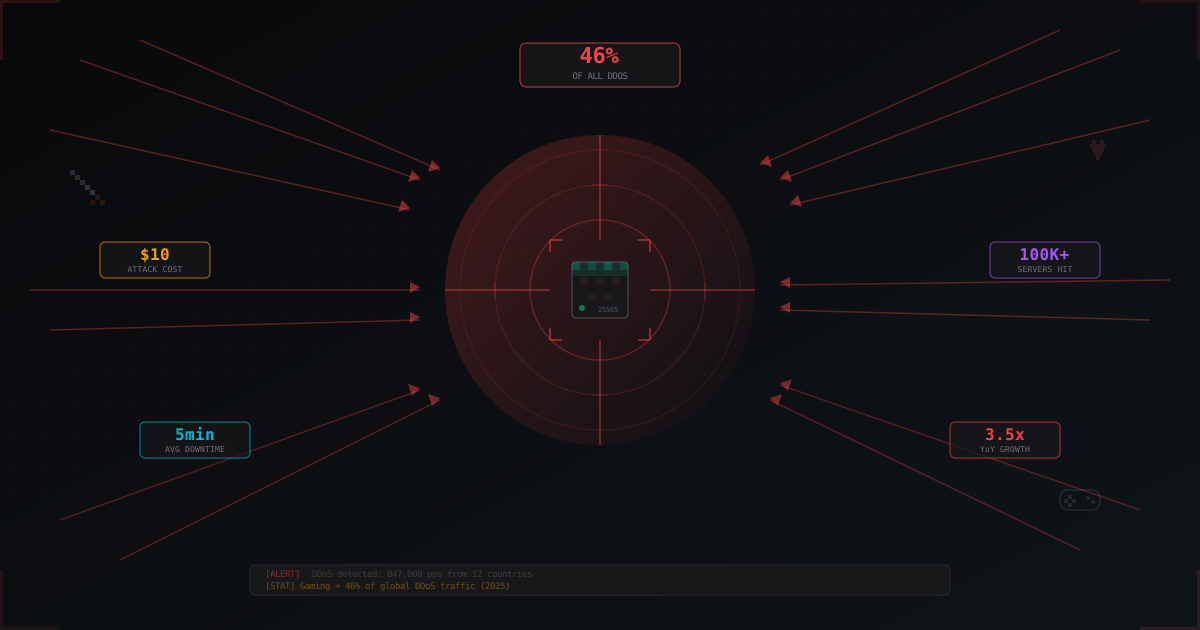
According to Cloudflare's 2025 data, 46% of all global DDoS traffic targets the gaming industry. Akamai reports a similar picture: gaming leads by a huge margin. Gcore's Q4 2025 report confirms it: gaming consistently ranks first among all industries for DDoS attack volume.
So why are gaming servers under fire? Let's break it down.
The Numbers Tell the Story
Let's start with the scale of the problem.
In 2025, DDoS attacks on gaming servers grew 3.5x compared to 2023. Average attack size is growing too: in 2022, a typical attack on a game server was 5-10 Gbps. By 2025, the average exceeded 50 Gbps. Record-breaking attacks are now measured in terabits.
Radware's 2025 report shows the average gaming DDoS attack lasts between 20 minutes and 2 hours. But some attacks persist for days or even weeks. Attackers increasingly use "pulsing" attacks: short 5-10 minute bursts with pauses in between, designed to bypass automated mitigation systems.
Minecraft holds a special place in this picture. According to multiple cybersecurity reports, Minecraft servers rank among the top three most attacked targets in the gaming industry. Hundreds of thousands of servers, open ports, predictable protocols.
Motivation: Who Attacks and Why
DDoS attacks on gaming servers have several primary motives. And they differ significantly from attacks on banks or government websites.
Competition Between Servers
This is the number one reason for Minecraft. The owner of Server A wants players to leave Server B and come to them. The easiest way? Take Server B offline. While the competitor is down, their players search for alternatives. And find Server A.
It sounds primitive, but it works. Especially in niche game modes where 5-10 servers offer the same gameplay. Losing your audience for a week can mean losing 30-50% of your regular players. Many simply never come back.
Revenge and Personal Conflicts
A former admin who got demoted. A banned player. An unhappy donor who was denied a refund. Someone who lost an argument in chat. The motives can be incredibly trivial.
This is especially common in the Minecraft community due to its younger audience and high emotional intensity. A teenager who had their privileges revoked can easily order a DDoS attack on a server. Especially when it costs less than a movie ticket.
Extortion
"Pay $200 in Bitcoin, or we'll take down your server." Dozens of servers receive messages like this every month. Sometimes the threat comes after a brief "demonstration" attack to prove they mean business.
Most experienced admins ignore these threats. But newcomers sometimes pay, which only encourages attackers to continue.
"Just for Fun"
A separate category of attackers do it purely for entertainment. They join a server, play for a bit, then "knock it down." Watch the reactions in Discord. Record a video. Share it in group chats.
For them, it is a form of digital vandalism: nothing personal, just "because I can." And unfortunately, the low barrier to entry makes it accessible to virtually anyone.
The DDoS-for-Hire Economy: Attacks Cost Less Than Protection
This is where things get terrifying.
The illegal DDoS-for-hire industry (they disguise themselves as "stresser" or "booter" services) is thriving despite law enforcement efforts. The cost of ordering an attack is extremely low — often cheaper than a monthly streaming subscription. Meanwhile, a single attacker can target dozens of servers, while each server must pay for its own protection separately. The economics clearly favor the attacker.
The power behind these services comes from botnets of infected IoT devices, rented servers, and amplification techniques that exploit misconfigured servers across the internet.
Why Gaming Servers Are So Vulnerable
Banks spend millions on cybersecurity. Major SaaS companies have entire DDoS mitigation teams. What about gaming servers?
Static IP Address
A gaming server by definition needs a fixed IP. Players save it to their favorites, server listings index it. Change your IP during an attack? You'll lose half your audience who doesn't know the new address. Plus, the new IP is usually found within hours.
Known Ports
Minecraft uses port 25565 by default. Even if you changed it, scanning the range and finding it takes minutes. The protocol is known, packet formats are documented. Distinguishing legitimate traffic from attack traffic at the packet level is not straightforward.
Limited Bandwidth
A typical dedicated Minecraft server has a 100 Mbps to 1 Gbps connection. That's 50-100x less than a typical DDoS attack in 2025. Even the most powerful server will go down under a 10 Gbps attack without specialized protection.
Cloud hosts like DigitalOcean or Hetzner typically just shut your server down when they detect DDoS. Nullrouting: your IP stops being routed at the network level, and your server becomes unreachable. Technically they protected you from the attack, but your server is still dead.
Young Administrators
A significant portion of Minecraft servers are run by people aged 14-25. Many are talented and motivated, but they lack experience in system administration and cybersecurity. They can configure plugins and create excellent gameplay, but properly setting up a firewall and choosing appropriate DDoS protection? That is a different skill set.
No Security Budget
For many servers, the budget is tight: hosting, plugins, maybe a domain. DDoS protection? "We'll get by without it, nobody has attacked us yet." This approach works until the first attack. And after the first attack, it is often too late: players have left, reputation is damaged, donations have dropped.
The Emotional Factor: Why Gaming Suffers More
In the banking sector, a DDoS attack means customers can't access online banking for a few hours. Unpleasant, but their money is safe, and they will come back.
In gaming, it is completely different.
When a game server goes down, players lose progress. They were in a raid, building a base, participating in an event. Everything interrupted. The emotional reaction is instant and intense.
What does a player do when a server goes down? Opens a server listing and joins a different server. Right now. They don't wait an hour or check back in 15 minutes. They leave and start playing somewhere else.
If attacks keep repeating, the server develops a reputation for being "unstable." Even if you fix the problem a week later, the label sticks. "That server that's always down."
Financial losses add up too. While your server is offline, there are no new donations. No new players. But hosting costs keep running. For servers that live on donations, three to four days of downtime can mean the difference between profit and loss for the entire month.
Minecraft: The Perfect Target
Among all games, Minecraft holds a special place in the DDoS context. Here is why.
Ecosystem Scale
According to various server monitoring services, hundreds of thousands of Minecraft servers run simultaneously on the internet. That is a massive attack surface. Every server is a potential target.
Open Protocol
The Minecraft protocol is well-documented and open. Libraries exist in Python, Java, and Go for interacting with servers. Creating a bot that connects to a server and sends specific packets is achievable with basic programming skills.
This opens the door not only to network-level DDoS but also to application-level attacks: bot flooding, join/quit exploits, crafting spam, chunk exploits.
Social Dynamics
The Minecraft community lives on Discord, Telegram, and forums. Conflicts between servers, between players, between clans are public. Information about how to "take down" a server spreads quickly. Entire Discord servers are dedicated to "stressing" Minecraft servers.
Famous Cases
Major Minecraft servers have repeatedly fallen victim to massive DDoS attacks. Hypixel, one of the largest servers in the world, regularly faces attacks measuring hundreds of gigabits. 2b2t, the famous "anarchy" server, has gone offline for days at a time due to attacks.
Smaller servers suffer even more because they lack resources for professional protection. For a small server with 50 players, a 5 Gbps attack is already catastrophic.
Why Regular Hosting Does Not Help
"My host says they have DDoS protection." Sound familiar? Let's examine what's behind that claim.
Typical Hosting: Nullroute
Most hosting providers simply nullroute your IP when they detect a DDoS attack. This means all traffic to your server stops being routed at the network level. The attack stops, but your server becomes unreachable too.
Some providers lift the nullroute after 1-2 hours. Others after 24 hours. Some hold it for days "as a precaution." During this time, your server is completely dead.
Basic L3/L4 Filtering
Some hosts offer basic network-level filtering: blocking UDP floods, SYN floods, and similar attacks. This helps against simple volumetric attacks but is useless against application-level attacks, which are increasingly used against gaming servers.
A protocol-level bot attack on Minecraft looks like normal player connections. Basic L3/L4 filtering simply cannot see it.
No Understanding of Gaming Protocols
This is the core problem. Generic DDoS protection does not understand the Minecraft protocol. It does not know what a legitimate handshake looks like. It cannot distinguish a real player from a bot. It cannot filter packets at the game protocol level.
Effective gaming server protection requires a tool that understands the specifics: how bot attacks work against Minecraft, what patterns characterize bots, and how to filter traffic without affecting real players.
The Arms Race: Attacks Grow, Protection Evolves
The DDoS industry never stands still. Every year, attacks become more sophisticated, more powerful, and cheaper. But protection evolves too.
Growing Attack Power
In 2020, a 100 Gbps attack was considered serious. In 2025, that is standard capacity for most DDoS-for-hire services. Record attacks now reach several terabits per second. IoT botnets continue to grow: billions of new devices connect to the internet every year, many with weak security.
Increasing Sophistication
Attackers have long moved beyond simple UDP flooding to complex multi-vector attacks. They combine L3/L4 attacks with application-level ones. Use pulsing patterns. Employ rate-limiting bypass techniques. Mimic legitimate traffic.
For Minecraft, this means that "block UDP" level protection stopped working long ago. Modern attacks use TCP, mimic the Minecraft protocol, and connect as "real" players.
Protection Evolution
In response, protection is also evolving. Solutions now analyze traffic at the application level, use machine learning for anomaly detection, and apply challenge-response mechanisms for player verification.
Services like MineGuard specialize specifically in gaming server protection and understand protocols at a deep level. This is fundamentally different from generic network filtering.
For more on how attack and defense methods are developing, see our article on DDoS trends for Minecraft in 2026.
What Attackers Gain
Let's summarize the motivations. What does someone actually gain from attacking a gaming server?
Competitor elimination. If you own a competing server and take your rival offline for a week, you might capture 20-40% of their audience. With average monthly donations of $500-1000, that is significant financial gain. Illegal, of course, but extremely difficult to prove.
Ransom. Some attackers profit from extortion. "$200 and we stop the attack." If 3 out of 10 targets pay, the monthly DDoS service subscription is already paid for.
Reputation in dark communities. In certain circles, "taking down a major server" is considered an achievement. It brings status in closed chats and forums. For teenagers, this can be a powerful motivator.
Nothing. Honest answer: most attackers gain nothing meaningful. No money, no real benefit. Just a temporary sense of power and adrenaline. But that is enough to keep the DDoS-for-hire industry thriving.
How to Protect Yourself: Basic Steps
Full DDoS protection deserves its own article (and we already wrote one), but here are the fundamentals.
Hide your real server IP. Use proxy-based protection that receives traffic on its own addresses and forwards only clean traffic to your server. If an attacker does not know your real IP, launching an effective attack becomes much harder.
Do not rely on your host. Your host's basic protection is designed to protect their infrastructure, not your specific server. You need specialized protection that understands gaming protocols.
Have an attack response plan. Know how to redirect traffic, how to notify players, how to quickly restore operations. Panic during an attack only makes things worse.
Free protection is better than none. If your budget is limited, start with free solutions at least. They will not save you from serious attacks, but they will filter basic junk. Read more about why free protection may not be enough in our article.
Bottom Line
Gaming servers remain the number one target for DDoS attacks. And the situation is not improving: attacks are getting stronger, cheaper, and more accessible. Attacker motivations range from financial to "just because I can." And gaming servers remain vulnerable due to static IPs, limited bandwidth, and lack of specialized protection.
The only reliable answer: specialized DDoS protection that understands gaming protocols and can tell a bot from a real player. Not nullrouting. Not a basic firewall. Full application-level filtering.
If you run a gaming server and have not thought about DDoS protection yet, the question is not whether you will be attacked. The question is when.
Protect Your Server from DDoS Attacks
Free protection with 5-minute setup. 1 TB bandwidth included.
Try for FreeRelated Articles
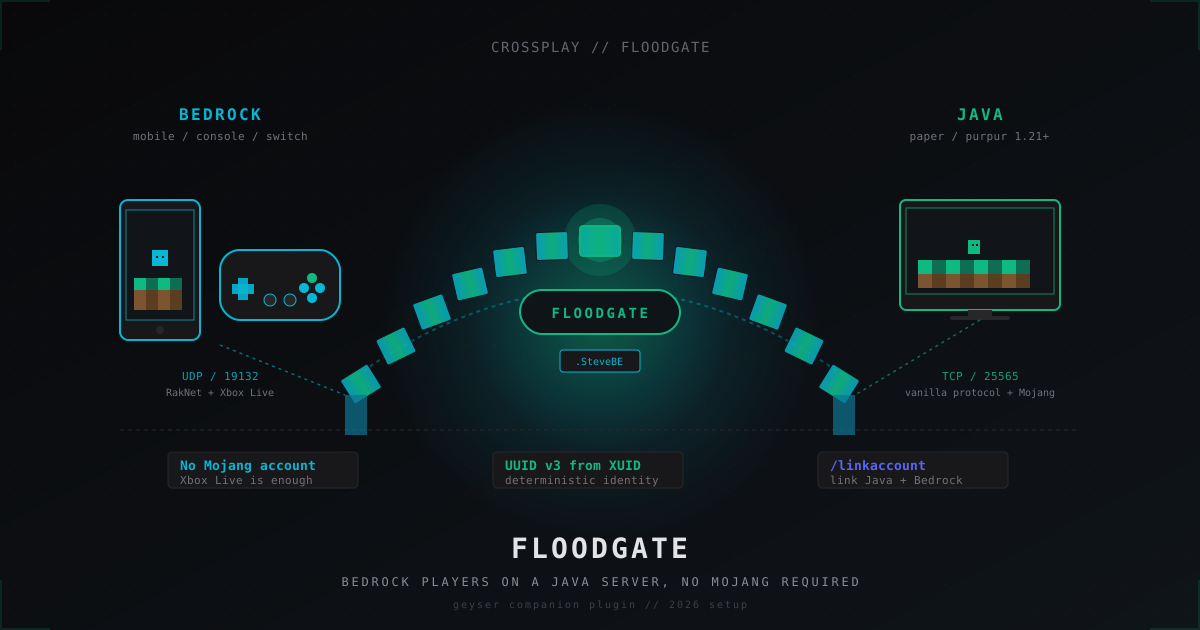
Floodgate: letting Bedrock players join Java servers without a Mojang account (2026)
Floodgate paired with Geyser is the official, Microsoft-blessed route from GeyserMC that lets phone, Switch and Xbox players onto a Java server without buying a separate Mojang account. Install, configs, UUID prefix, /linkaccount and the anti-abuse story.
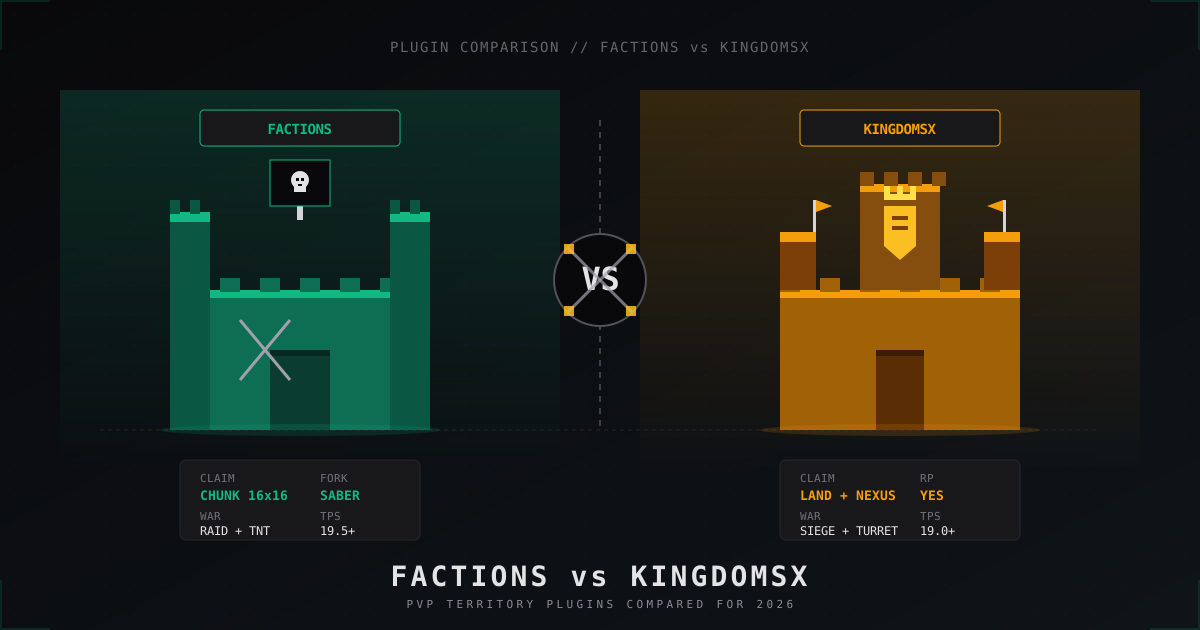
Factions vs KingdomsX: which PvP plugin to pick in 2026
Honest 2026 comparison of SaberFactions and KingdomsX: claiming, war, sieges, economy, performance, addons and which faction plugin fits which server style.
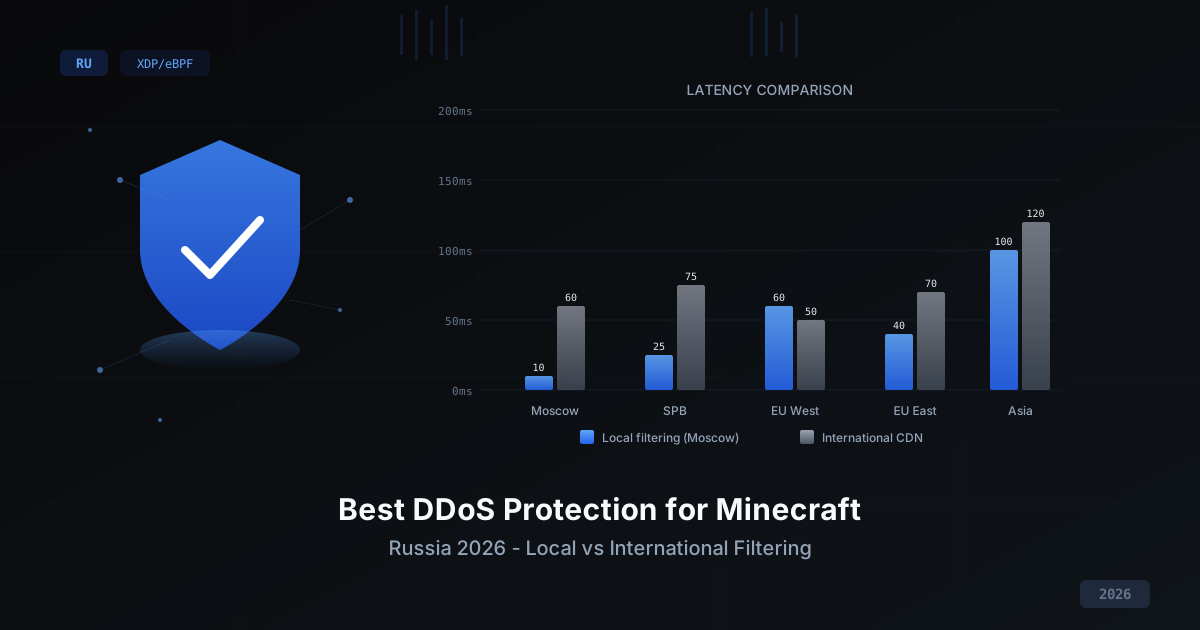
Best DDoS Protection for Minecraft in Russia 2026
Comparing DDoS protection approaches for Minecraft servers in 2026: international CDN vs local filtering, self-hosted vs managed, free vs paid. Selection criteria, XDP/eBPF technology breakdown, and why latency matters for PvP gameplay.