Plugins vs Protection Service: What Actually Works Against Bots in 2026
You run a Minecraft server. You get hit by bots. You Google "minecraft anti-bot plugin" and install the first thing you find. Sound familiar?
This article is not about selling you anything. It is an honest breakdown of what works, what used to work, and what is just giving you a false sense of security in 2026. We will look at specific plugins by name, explain why in-game checks are hitting a wall, and talk about what the servers that actually survive bot attacks are doing differently.
The Bot Problem in 2026
Let's start with what you are actually up against.
In 2023-2024, most Minecraft bots were dumb. They connected, maybe sent a few packets, and that was it. A basic connection limiter or a simple captcha could stop them. Those days are over.
Modern bot clients in 2026 are sophisticated software. They mimic real player behavior - proper packet timing, realistic movement patterns, correct protocol sequences. Some even simulate mouse movement jitter so their actions look human. These are not quick hacks. They are actively maintained tools with Discord communities, update channels, and bypass databases.
The scale changed too. Renting a botnet that can throw 5,000-10,000 simultaneous connections at your server costs practically nothing. We are talking about the price of a coffee. And these botnets use residential proxies, so you cannot just block an IP range - each bot comes from a different household IP in a different country.
This is not theoretical. Servers get hit daily. Small servers, large servers, it does not matter. If your server is listed anywhere public, you are a target.
Plugin-Based Protection - The Popular Options
Let's go through the plugins that most server owners reach for. No sugarcoating.
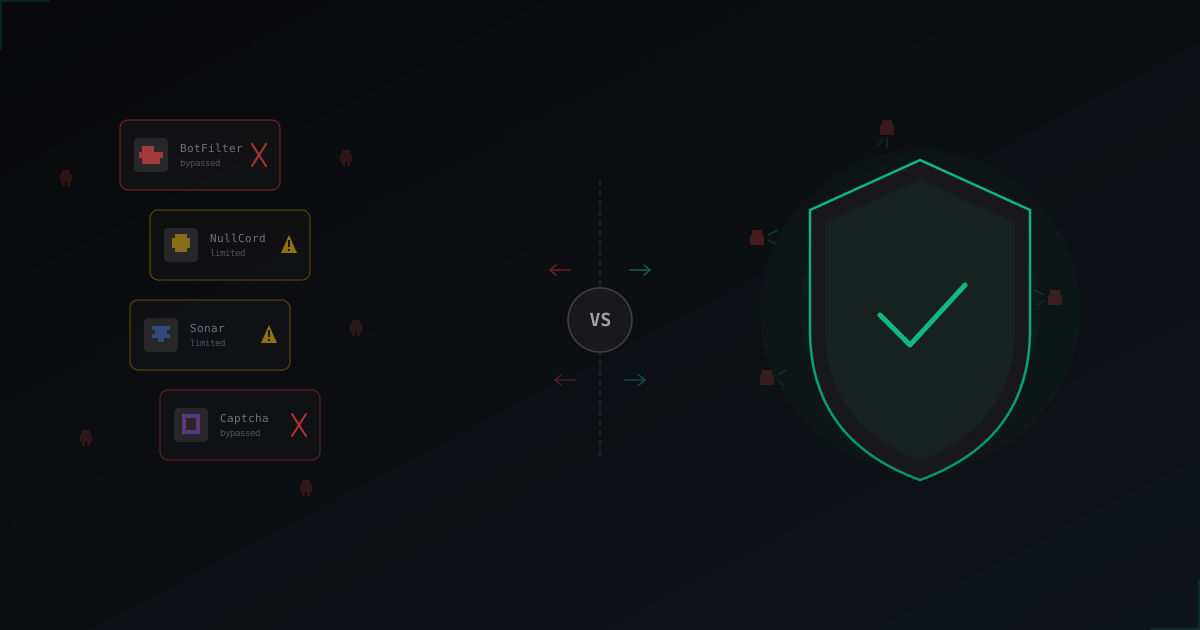
BotFilter (by Leymooo)
BotFilter was one of the first dedicated anti-bot solutions for Minecraft. It checks connecting players by making them fall onto a platform and verifying their movement physics. Some versions add captcha via item crafting or chat input.
What it did well: When it came out, the fall check was clever. Real Minecraft clients calculate fall physics in a predictable way. Bots at the time just connected and sat there, so they instantly failed the check.
The problem in 2026: Bot developers figured out the fall physics years ago. Modern bot clients calculate the exact same gravity and movement values that a real client does. They pass the fall check every time. The item crafting captcha? Bots just send the right inventory click packets. There is no actual crafting happening - it is all packet manipulation.
BotFilter is open source. Every check it performs is readable in the code. Bot developers literally run BotFilter on a test server, connect their bot, see what fails, and fix it. The cycle from new check to bypass is measured in days, sometimes hours.
Verdict: Better than nothing, but against any targeted attack in 2026, it will not hold.
NullCord
NullCord takes a more advanced approach. It does packet-level analysis, checks timing between specific protocol events, and looks at behavioral patterns during the login sequence.
What it does well: The packet analysis is genuinely smart. It catches bots that do not perfectly replicate the vanilla client's packet ordering and timing. The timing checks are harder to bypass than simple physics checks because they require more precise protocol knowledge.
The problem: As of 2026, specialized bot clients have NullCord-specific bypass modules. These modules know exactly what timing windows NullCord expects and replicate them. The bot client communities actively share bypass configs that get updated within days of NullCord releases.
NullCord developers are responsive and keep updating detection. But it is an arms race where the defenders are always one step behind. An update goes out, protects for a few days, then the bypass drops.
Verdict: One of the better plugin options. If you must use a plugin, this is a reasonable choice. But do not expect it to stop determined attackers.
Sonar
Sonar is a more modern anti-bot plugin that combines packet analysis with behavioral detection. It uses protocol-level checks alongside connection pattern analysis.
What it does well: Clean codebase, good detection algorithms, actively maintained. The combination of checks makes casual bot attacks fail. It handles drive-by attacks - where someone just points a basic bot tool at your server - reasonably well.
The problem: The same fundamental issue. Bypass methods exist and some are publicly shared. Sonar's detection heuristics, while good, run inside the Minecraft server environment with the same limitations as every other plugin. Bot developers test against it just like they test against everything else.
Verdict: Probably the best pure-plugin option available right now. Use it if you want a plugin layer. Just know its limits.
In-Game Captcha Plugins
Various plugins implement captcha directly inside Minecraft. The player gets teleported to a room and has to type text shown in chat formatting, solve a math problem, craft a specific item, or click items in an inventory GUI.
Here is the hard truth: Every single one of these methods is trivially bypassable in 2026.
- Text captcha in chat? Bots read chat packets and parse text. There is no image to OCR - it is literally text data in a packet.
- Image-based captcha using maps? Neural networks in 2026 solve these in milliseconds. The same technology that reads handwritten text for banks can certainly read blocky Minecraft map art.
- Math problems? Bots parse the equation from the chat packet and calculate the answer.
- Item crafting? Bots send the correct inventory click packets. They do not need to "see" the inventory - they just send the packet sequence that corresponds to clicking the right slot.
- GUI click challenges? Same thing. The bot receives the inventory open packet, reads the slot data, and sends back a click on the correct slot.
The fundamental issue: in-game captcha is happening inside the Minecraft protocol. Bots speak this protocol natively. You are asking the bot to do something in the bot's own native language.
Verdict: Not reliable. Adds friction for real players while barely slowing down modern bots.
Why In-Game Checks Are Fundamentally Limited
This section matters. It is not about specific plugins being bad - it is about why the entire approach has a ceiling.
Problem 1: Checks happen after connection. Every in-game check - fall, captcha, behavioral - happens after the bot has already connected to your server. It has already consumed a connection slot, already triggered your server to allocate memory for that player, already started loading chunks. During a 10,000-bot attack, you now have 10,000 connections consuming resources while your plugin tries to verify each one. Even if your plugin catches every bot in 3 seconds, those 3 seconds with 10,000 concurrent connections can bring a server to its knees.
Problem 2: Your CPU is doing the checking. The anti-bot plugin runs on the same hardware as your game server. During an attack, your server is already under stress from the flood of connections. Now your plugin is adding additional CPU load to analyze each one. The attack itself degrades the protection's ability to function.
Problem 3: Attackers have your source code. Most popular anti-bot plugins are open source. Attackers download them, set up test environments, and methodically bypass each check. Closed-source plugins fare slightly better, but reverse engineering a Java plugin is not hard. Decompilers produce nearly perfect source code.
Problem 4: The protocol limits what you can check. Minecraft's protocol was designed for gameplay, not security verification. The range of "challenges" you can present to a connecting client is limited to things the protocol supports: movement, inventory interaction, chat, and a few other actions. All of these can be automated.
Problem 5: There is no way to verify the client itself. You cannot check if the connecting software is actually Minecraft or a bot client. The protocol looks identical. There is no cryptographic attestation, no client certificate, no trusted execution environment. Any program that sends the right packets is indistinguishable from a real player.
These are not problems that a cleverer plugin can solve. They are architectural limitations of the approach.
External Protection Services - A Different Approach
A fundamentally different approach: filter the traffic before it ever reaches your server.
External protection works by sitting between the internet and your Minecraft server. Players connect to the protection service first. Traffic gets analyzed, filtered, and only legitimate connections are forwarded to your actual server.
This changes the equation in several important ways.
DDoS absorption at the network level. Volume-based attacks - SYN floods, UDP amplification, raw bandwidth attacks - get absorbed by the protection service's infrastructure. Your server never sees this traffic. The protection service has the bandwidth capacity to handle it. Your server does not, and it was never designed to.
Connection filtering before resource consumption. Protocol violations, malformed packets, suspicious connection patterns - all caught before a single byte reaches your server. During an attack, your server continues running normally because the garbage traffic never arrives.
Web-based captcha verification. This is where it gets interesting. Instead of asking a connecting player to do something inside Minecraft, the protection service can redirect unverified players to a web page. The player opens a link in their browser, completes a verification challenge, and gets cleared to connect.
Why is this so effective? Because Minecraft bots are Minecraft clients. They speak the Minecraft protocol. They do not have a web browser. They cannot execute JavaScript. They cannot render a web page. They cannot interact with a browser-based challenge.
This is not a theoretical advantage. The server ReallyWorld uses web captcha for verification. Bots cannot get past it. Compare this to servers running BotFilter, where new bypass scripts appear within days of any update. The difference is that web captcha forces the attacker to solve a completely different problem - not "how do I fake Minecraft behavior" but "how do I run a full browser with JavaScript execution." That is an orders-of-magnitude harder problem.
Could someone eventually automate a headless browser to pass web captcha? In theory, yes. In practice, browser fingerprinting, behavioral analysis, and the sheer complexity of maintaining a browser automation pipeline alongside a Minecraft bot client makes this impractical for the vast majority of attackers. The cost-benefit ratio shifts dramatically in the defender's favor.
Our Approach - Why We Skip In-Game Checks
This is the part where we talk about what we do at MineGuard, and more importantly, why.
We made a deliberate choice not to implement in-game interactive checks. No fall verification, no item crafting captcha, no chat puzzles. This was not laziness or cutting corners. It was a technical decision based on watching the plugin anti-bot space for years.
Here is what we observed: every in-game check gets bypassed. Every single one. BotFilter's fall check? Bypassed. NullCord's timing checks? Bypass modules released. Sonar's behavioral detection? Workarounds shared in bot communities. The cycle repeats endlessly - plugin updates, bypass appears, plugin patches, new bypass appears.
What we do instead:
Packet-level filtering at the proxy layer. We analyze Minecraft protocol traffic at our proxy infrastructure. Malformed packets, protocol violations, impossible packet sequences - these get caught and dropped before forwarding. This is not in-game verification. This is network-level traffic analysis.
Behavioral analysis of connection patterns. We look at how connections arrive, not what happens after connection. Connection rate, source distribution, protocol handshake patterns - all analyzed before the player ever reaches your server.
Web-based captcha for persistent threats. When bots pass protocol-level checks (and some will), we have web captcha as the next layer. The player gets a link, verifies in their browser, and connects. Real players do this once and play. Bots hit a wall they cannot climb.
The ReallyWorld example keeps coming up because it demonstrates this perfectly. They use web captcha. Their bot problem is solved. Meanwhile, servers that rely on in-game plugins rotate through BotFilter, NullCord, Sonar, and various captcha plugins, and still get hit every time a new bypass drops.
We are not claiming our approach is perfect. No solution is. But we believe that fighting bots inside their own environment - the Minecraft protocol - is a losing strategy. Moving the verification to an environment the bots cannot operate in - a web browser - changes the game.
What Actually Works - Honest Recommendations
Whether you use MineGuard or not, here is a layered approach that works in 2026:
Layer 1: External DDoS protection. You need something between the internet and your server that can absorb volume attacks. This is non-negotiable for any server that cares about uptime. Your 10 Gbps server link cannot survive a 50 Gbps flood. An external protection service with proper network capacity can.
Layer 2: Protocol-level filtering at the proxy. Catch malformed packets, enforce rate limits, drop protocol violations. This should happen before traffic reaches your game server. If you use a proxy like Velocity or BungeeCord, this layer sits at the proxy level.
Layer 3: Behavioral analysis of connections. Look at connection patterns - not what happens in-game, but how connections arrive. Sudden spike from 500 different IPs in the same /16 subnet? Suspicious. 200 connections per second all sending identical handshake timing? Flag it. This is about traffic analysis, not gameplay verification.
Layer 4: Web-based captcha for what gets through. Some bots will pass protocol checks. They are good enough at mimicking the protocol. For these, redirect to browser-based verification. This is the layer that stops sophisticated bots.
Optional Layer: Plugins as defense-in-depth. If you want to run Sonar or NullCord as an additional layer behind everything else - go for it. Defense in depth is a valid strategy. Just do not make it your primary or only defense. Use it as a trip wire, not a fortress wall.
Do not rely on any single solution. Not a single plugin. Not a single service. Layer your defenses so that bypassing one layer does not mean free access to your server.
Comparison Table
| Method | Effectiveness 2026 | Bypass Difficulty | Server Load | Cost |
|---|---|---|---|---|
| BotFilter | Low-Medium | Easy (scripts) | High | Free |
| NullCord | Medium | Medium (specialized bots) | Medium | Free |
| Sonar | Medium | Medium | Medium | Free |
| In-game captcha | Low | Easy (scripts/neural networks) | High | Free |
| External DDoS proxy | High | Hard | None (on your server) | Paid |
| Web captcha | High | Very hard | None (on your server) | Paid |
The table tells the story. Free plugin solutions provide medium protection at best and put additional load on your hardware. External services cost money but remove load from your server and provide stronger protection.
The best setup? Combine them. External DDoS proxy plus web captcha as primary defense, with a plugin like Sonar running behind it as an extra layer. You get the best of both worlds, and an attacker has to beat multiple independent systems to get through.
No protection is unbreakable. But the goal is not perfection - it is making your server more expensive to attack than it is worth. Layered defense achieves that.
Protect Your Server from DDoS Attacks
Free protection with 5-minute setup. 1 TB bandwidth included.
Try for FreeRelated Articles
Multiverse-Core: Run Multiple Worlds on One Minecraft Server
Complete Multiverse-Core guide: install, commands, portal blocks, split inventories, custom generators, and the real performance gotchas.
How to Install Plugins on a Minecraft Server: Complete Guide
Step-by-step guide to installing plugins on a Minecraft server: where to download, how to install, how to fix errors. Bukkit, Spigot, Paper - practical walkthrough.