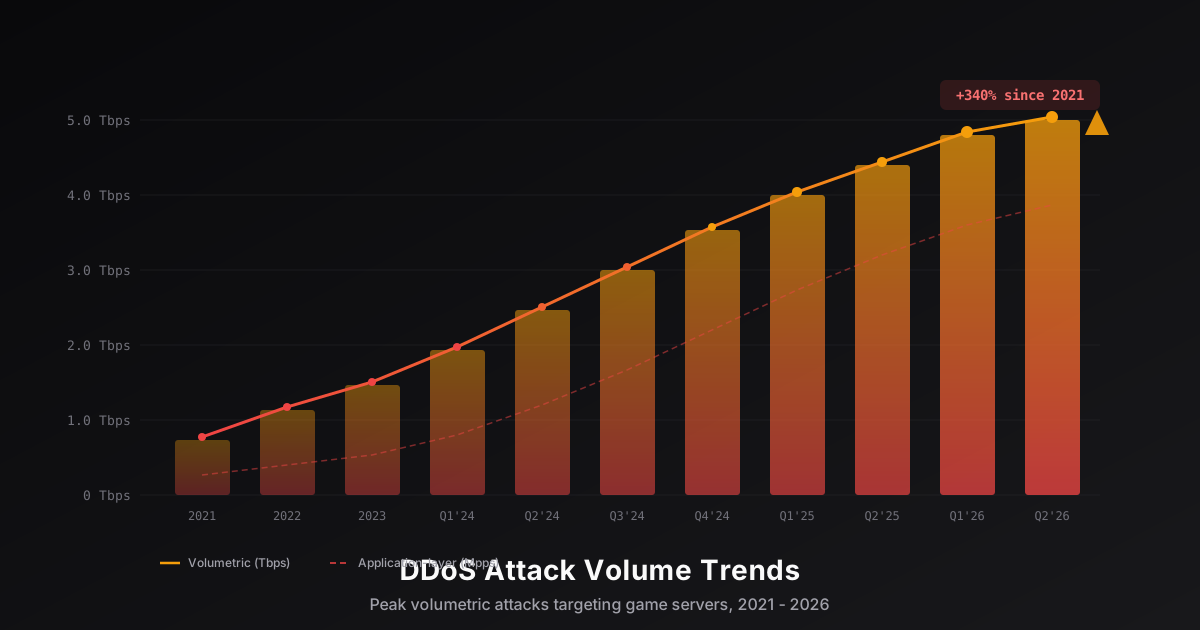
DDoS Attack Trends Targeting Game Servers in 2026
The first quarter of 2026 has already made it clear that DDoS attacks on game servers continue to escalate. According to Cloudflare's Q4 2025 quarterly report, the gaming sector consistently ranks among the top three most targeted industries, with average network-layer attack volumes up 28% year over year. For administrators of Minecraft, Rust, ARK, and other game servers, the takeaway is straightforward - protection is no longer optional.
This article breaks down the key DDoS attack trends shaping the gaming infrastructure landscape in 2026 and what to do about them.
Volume Growth: The Terabit Era
Back in 2022, a 1 Tbps attack was headline news. By early 2026, such volumes have become routine. Cloudflare recorded a record-breaking 5.6 Tbps attack in late 2024, and Akamai's 2025 quarterly reports consistently show 30-40% growth in peak values each quarter.
For game servers, this translates to specific numbers. Attacks that used to generate 10-50 Gbps now regularly hit 100-300 Gbps. The reason is simple - the cost of generating traffic keeps falling. Renting a botnet capable of pushing 100 Gbps costs roughly a few dozen dollars per hour. Availability is increasing, the barrier to entry is dropping.
What this means for server owners: local protection through iptables or built-in hosting tools no longer works for serious attacks. You need traffic filtering at the network provider level or through a specialized service capable of handling hundreds of gigabits of inbound traffic without degradation.
Application-Layer Attacks Are Getting Smarter
Volumetric attacks are brute force. The more serious problem in 2026 is application-layer (L7) attacks that mimic legitimate traffic. According to Akamai's State of the Internet report for 2025, L7 attacks now account for 45% of total attack volume, and the trend is continuing.
In the Minecraft context, this means attacks that simulate full player connections. The attacking bot establishes a TCP connection, sends a proper Handshake, requests server status, or even begins the login process. To basic filters, it looks like a normal player. To the server, it is thousands of simultaneous connections consuming memory and CPU.
These attacks are especially dangerous because they pass through most volumetric filters. A SYN flood is easy to block by pattern, but a properly formed Login Start packet from a bot looks identical to one from a real player. The difference is in behavior: bots do not respond to certain checks, have anomalous timing between packets, and fail Velocity/BungeeCord Cookie verification.
Evolution of Minecraft-Specific Attacks
Minecraft remains one of the top DDoS targets in the gaming sector. The game's protocol is well documented, tools for generating attack traffic are available in public repositories, and attacker motivations range from server competition to straightforward extortion.
Several notable evolutions are visible in 2026:
Protocol-aware floods. Attacks that account for the specifics of the Minecraft protocol. Instead of random UDP junk - streams of properly formed packets that the server attempts to process. Query floods target the server status mechanism, Login floods create load on the authentication system.
Amplification via Minecraft servers. Attackers use open Minecraft servers with enabled Query as amplifiers. A single small request generates a response 5-10 times larger. With thousands of open servers available, this provides a multiplier that amplifies attacks without the attacker's own resources.
Combined attacks. Simultaneous launch of a volumetric attack (to saturate bandwidth) and an application-layer attack (to overwhelm the server itself). While defenses deal with one vector, the other gets through. Such multi-vector approaches have become the norm, not the exception.
Scheduled targeted attacks. Attackers study a server's peak hours (Friday evening, weekends, event times) and launch attacks precisely when damage is maximized. These are no longer random spikes but a deliberate strategy.
Carpet Bombing vs. Targeted Attacks
Two opposite approaches that are both gaining popularity simultaneously.
Carpet bombing distributes attack traffic across an entire /24 or even /16 subnet. Instead of attacking a single IP, the attacker sends a moderate flow (50-200 Mbps) to every address in the subnet. Individually, each flow falls below detection thresholds. In total - tens to hundreds of gigabits overwhelming the uplink. Cloudflare noted a 40% increase in carpet bombing attacks in their Q3 2025 report compared to the previous year.
For hosting providers running Minecraft servers on dedicated IPs within a single subnet, this means an attack on one customer can impact everyone. Defending against carpet bombing requires filtering above the individual host level - at the network level.
Targeted attacks take the opposite approach. All power is directed at a single IP and port. The attacker knows the exact server address and strikes with precision. These attacks are more efficient in terms of the attacker's resource expenditure and are often preceded by reconnaissance - port scanning, version detection, vulnerability probing.
IoT Botnet Growth
Botnets built from compromised IoT devices remain the primary source of DDoS traffic. IP cameras, routers, smart devices with default passwords or known vulnerabilities - all of this becomes part of botnets. According to the ENISA Threat Landscape 2025 estimates, the number of exploitable IoT devices has grown to 15 billion, with a significant portion never having received a firmware update.
For the gaming sector, this creates a specific problem: IoT botnets generate traffic from real residential IP addresses. Blocking by ASN or GeoIP is ineffective - the attacking devices are on the same networks as legitimate players. Filtering must operate at the behavioral analysis level, not at the IP reputation level.
Particularly notable is the growth of botnets based on MIPS and ARM devices - routers and cameras that are mass-infected through exploitation of known CVEs. Mirai variants continue to evolve: new builds add support for additional architectures and use more sophisticated C2 protocols for resilience.
The DDoS-as-a-Service Landscape
The DDoS service market continues to grow and become more structured. This is a fact that must be factored into protection planning, not ignored. According to Europol's Internet Organised Crime Threat Assessment 2025, the number of booter/stresser services has not decreased despite regular law enforcement operations (Operation PowerOFF and similar).
What has changed in 2026:
- Subscription models with guaranteed capacity and SLA. Yes, attacks now come with SLAs.
- Target specialization: separate services for attacking game servers, separate ones for websites.
- Use of Telegram and Discord as sales and management platforms.
- Cryptocurrency payment integration for anonymity.
For defense, this means attacks have become accessible to virtually anyone, and motivation can be trivial - anger over a ban, competition between servers, simple boredom. Protection must work automatically and continuously, not on-demand.
New Defense Technologies: XDP/eBPF and ML
The industry's response to growing attacks has been the development of kernel-level filtering technologies in Linux.
XDP (eXpress Data Path) enables packet processing at the NIC driver level, before packets enter the main network stack. Performance - 14+ million packets per second on a single CPU core. That is an order of magnitude faster than iptables and allows filtering serious volumetric attacks without specialized hardware.
eBPF makes it possible to write filtering programs that execute directly in the kernel with safety guarantees. This is programmable filtering: you can implement complex packet inspection logic (Minecraft protocol validation, packet sequence checking, per-IP rate limiting) without the latency typical of userspace solutions.
At MineGuard, this is exactly the approach we use. Our XDP/eBPF-based filter analyzes every packet at the driver level, validates it against the Minecraft protocol, tracks connection state, and makes pass/drop decisions in microseconds. This allows handling large-scale attacks without adding latency for legitimate players.
Machine learning is beginning to play a meaningful role in anomaly detection. Not in the marketing sense where every if-else is called AI, but in specific applications: traffic pattern classification, bot identification through packet timing characteristics, adaptive threshold adjustment. ML models are well suited for separating bots from players based on a combination of signals that are difficult to describe with manual rules.
The IPv6 Challenge
The transition to IPv6 creates new challenges for DDoS protection. The enormous address space (a /64 subnet contains 2^64 addresses) renders traditional IP-based blocking approaches meaningless. A bot can change its address with every packet while staying within its allocated subnet.
For game servers, IPv6 is not yet the primary protocol - most Minecraft servers run on IPv4. But major hosting providers already offer dual-stack, and attackers are beginning to use IPv6 to bypass protection configured only for IPv4. In 2026, this is a transitional problem, but it is intensifying.
Effective IPv6 traffic filtering requires working with prefixes rather than individual addresses, along with deeper packet analysis, since the reputation of a single IPv6 address is practically useless.
How Protection Services Are Adapting
DDoS protection providers are responding to new trends in several ways:
Distributed filtering. Instead of a single scrubbing center - dozens of points of presence. Traffic is filtered closer to the source, reducing load on backbone links and lowering latency. Cloudflare, Akamai, and other major providers use anycast networks with hundreds of locations.
Always-on protection. Continuous filtering without switching. Previously, many services only routed traffic through filters upon attack detection, creating a 30-60 second window. In 2026, the standard is always-on filtering where traffic continuously passes through the scrubbing system.
Programmable rules. The ability for customers to customize filtering logic for their needs. For game servers, this is critical - filtering rules for Minecraft are fundamentally different from rules for web traffic.
API-driven management. Automating attack response through APIs. A game server can automatically tighten filtering when anomalies are detected and relax it when traffic normalizes.
MineGuard implements these principles specifically for game servers: always-on XDP-level filtering, continuous server health monitoring, and automatic rule adaptation based on the current traffic profile.
Predictions for the Remainder of 2026
Based on current data and trends, several well-grounded predictions can be made:
Growing average volumes. The median DDoS attack size against game servers will likely exceed 50 Gbps by the end of 2026. Peak attacks in the terabit range will become more frequent.
Further specialization. Attacks will increasingly account for the protocols of specific games. For Minecraft, this means more advanced bots that mimic real client behavior, including responses to Challenge packets.
Increased regulation. Law enforcement will continue operations against booter services. Europol and the FBI have been running such operations since 2018, and while completely eradicating the market has proven impossible, it raises risks for operators and temporarily reduces available capacity.
Defense consolidation. Smaller DDoS protection providers will be forced to merge or exit the market. Effectively filtering terabit-scale attacks requires infrastructure that is difficult to build from scratch.
IPv6 as an attack vector. By end of 2026, the share of IPv6-based attacks could reach 15-20% of total volume in the gaming sector.
Practical Recommendations
For game server administrators who want to prepare for current and future threats:
-
Use specialized protection. General-purpose CDNs and generic DDoS filters do not understand game protocols. You need a service that parses traffic at the game protocol level.
-
Hide your server's real IP. If an attacker knows the direct address, they can bypass any proxy. Use proxy servers, SRV records, and avoid exposing IPs in DNS history.
-
Monitor your traffic. Understanding your server's normal traffic profile is the foundation for detecting anomalies. Track pps, bps, connection counts, and geography.
-
Prepare an incident response plan. Know in advance what to do during an attack. Who to contact, what settings to change, how to switch DNS.
-
Keep software updated. Patches for Minecraft server, proxies (Velocity, BungeeCord), and plugins. Known vulnerabilities are ready-made attack vectors.
-
Do not rely solely on IP blocking. In the era of IoT botnets and IPv6, blocking individual addresses is treating symptoms. You need behavioral filtering.
DDoS attacks on game servers are not going away. They will grow in volume, become more sophisticated, and more accessible all at once. The only sustainable approach is investing in modern protection that can adapt to new threats as fast as they appear.
Protect Your Server from DDoS Attacks
Free protection with 5-minute setup. 1 TB bandwidth included.
Try for FreeRelated Articles
BetonQuest: Minecraft Server Quest Setup (Complete 2026 Guide)
Full BetonQuest 2.x guide: installation, package layout, conversations, objectives, conditions, events, journal, 1.x migration and TPS bottlenecks.
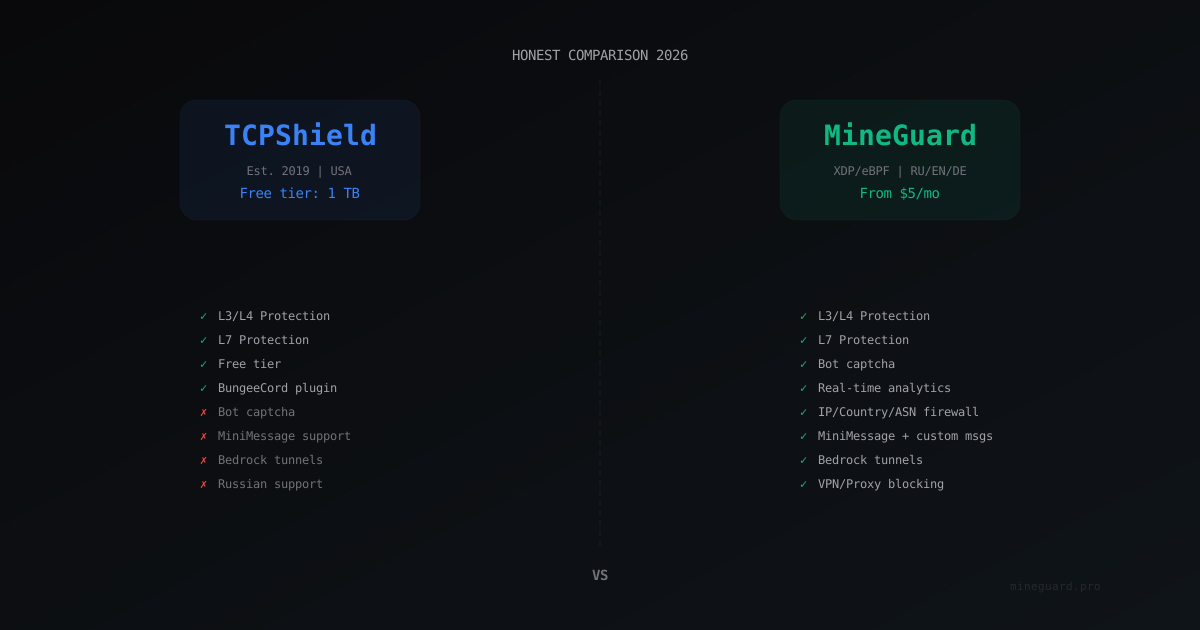
TCPShield vs MineGuard: Honest DDoS Protection Comparison for Minecraft in 2026
A detailed comparison of two popular Minecraft DDoS protection services. Features, pricing, support, and how to choose.
How to Protect Your Minecraft Server from DDoS Without Any Technical Knowledge
Don't know Linux or iptables? No problem. Here's how I protected my Minecraft server in 5 minutes without typing a single console command. MineGuard handles all the technical stuff for you.