Botnet Attacks on Minecraft in 2026: Records, Trends, and How to Protect Yourself
The Scale of the Problem: Numbers That Are Hard to Believe
2024 and 2025 became turning points for the gaming industry in terms of cybersecurity. Minecraft, the world's largest game with over 180 million active players, found itself at the epicenter of a new wave of DDoS attacks.
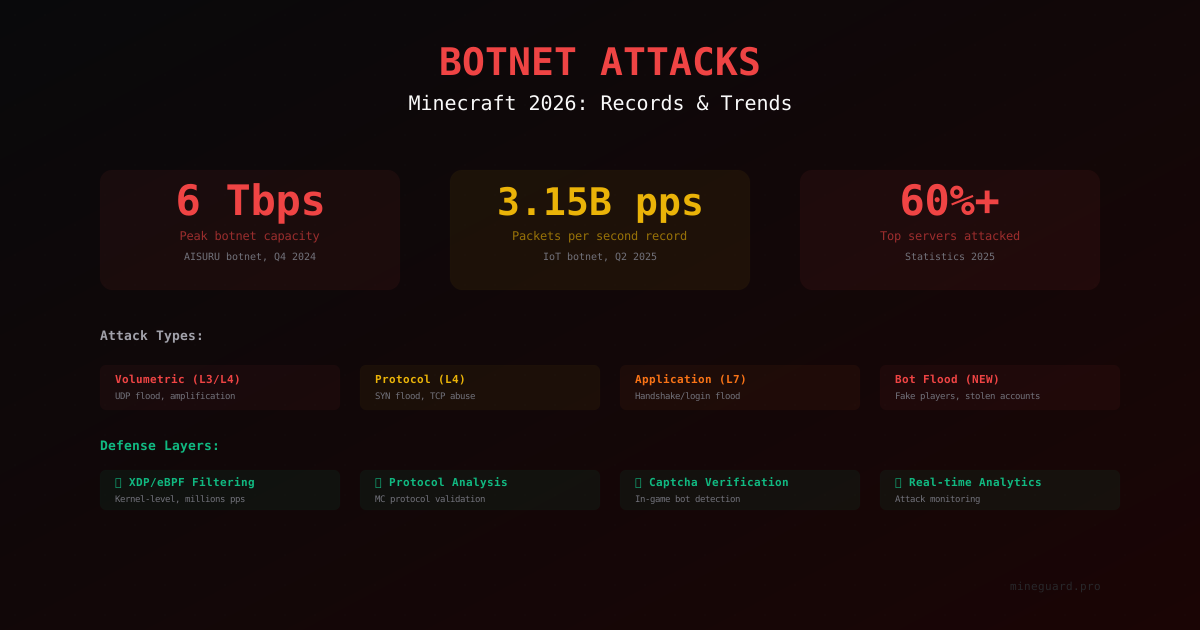
The raw facts: in late 2024, the AISURU botnet demonstrated a peak capacity of 6 Tbps - an absolute record for the DDoS industry. To put this in perspective, that volume of traffic is equivalent to simultaneously downloading roughly 750,000 HD movies per second. A single botnet capable of overloading a major data center's uplink dozens of times over.
In early 2025, Gcore detected and mitigated a 1 Tbps attack aimed specifically at a Minecraft server. This is not just a number from a report - it was a real attack on a real gaming project. Around the same time, Cloudflare reported mitigating an attack of 3.15 billion packets per second. Every packet is a separate request the server must process, classify, and drop.
According to 2025 statistics, over 60% of servers from the top-100 Minecraft monitoring lists were hit by noticeable DDoS attacks at least once. Some projects face attacks daily.
Why Minecraft Is Target Number One
It might seem strange: why Minecraft specifically, and not banks, crypto exchanges, or government websites? There are several reasons, all tied to economics and technical specifics.
Money talks. Large Minecraft servers are businesses with revenue ranging from thousands to hundreds of thousands of dollars per month. Donations, ranks, in-game currency. An hour of downtime for a top server can cost hundreds of dollars. This creates a direct incentive for competitors, extortionists, and plain troublemakers.
Low barrier to entry. Minecraft servers typically use standard ports and run on predictable stacks (Java Edition on TCP:25565, Bedrock on UDP:19132). Unlike corporate infrastructure, most servers don't have dedicated security teams.
The Minecraft protocol is vulnerable by design. The Minecraft protocol was built for gaming, not security. The handshake process allows sending crafted packets that force the server to spend resources on processing before any authentication occurs. This makes application-layer attacks particularly effective.
Young audience. A significant portion of server administrators are teenagers and young adults without deep knowledge of network security. They are more likely to neglect protection or misconfigure it.
Attack Types: From Brute Force to Smart Bots
DDoS attacks on Minecraft servers can be divided into four main categories. Each requires its own approach to defense.
Volumetric Attacks
The classic approach. The goal is to flood the channel with junk traffic. UDP flood, DNS amplification, NTP amplification. The attacker sends minimal data, while the victim receives tens of times more due to amplification through vulnerable servers on the internet.
In 2025-2026, volumetric attacks have crossed the multi-terabit threshold. Amplification vectors using open DNS resolvers and memcached servers remain relevant despite all community efforts to eliminate them.
Against volumetric attacks, only network-level filtering before traffic reaches the server helps. This is why XDP/eBPF filtering, operating at the network driver level, has become the standard for serious Minecraft protection. XDP processes packets before they enter the Linux kernel's network stack, allowing millions of packets per second to be filtered without CPU overhead.
Protocol Attacks
These attacks aim to exhaust server resources by abusing network protocol features. SYN flood, ACK flood, TCP stack attacks. The server wastes memory on half-open connections and state tables.
For Minecraft Java Edition running over TCP, SYN flood remains one of the most common attacks. The server tries to process thousands of spoofed connection requests and exhausts its connection limits.
Defense: kernel-level SYN cookies, per-IP rate limiting, automatic anomaly detection in connection patterns. A good protection system tracks the rate of SYN packets from each address and blocks anomalous sources in real time.
Application Layer Attacks
The most insidious type. The attacker sends technically valid requests that force the server to perform heavy operations. In the Minecraft context, this includes:
- Handshake flood - thousands of server status ping packets. Each requires the server to generate a response with MOTD, player list, and server icon.
- Login flood - mass login attempts that load the server's Java process.
- Exploit packets - specially crafted packets exploiting bugs in data processing (overly long strings, malformed NBT data).
These attacks are the hardest to filter because the traffic looks almost legitimate. Deep packet analysis at the Minecraft protocol level is needed: handshake sequence verification, data format validation, behavioral pattern tracking.
Bot Attacks (Bot Flood)
The trend of 2025-2026. Instead of junk traffic, attackers use botnets that mimic real player behavior. Bots complete the full connection cycle: handshake, login, join. They enter the server, create load on chunks, mobs, and world physics.
New-generation botnets use stolen or purchased accounts, bypass basic authentication, and even simulate player movement. Distinguishing a bot from a real player based on network packets alone is becoming increasingly difficult.
Bot attacks are countered by a comprehensive approach: captcha verification on connection, post-login behavior analysis (clicks, mouse movement, movement patterns), plus limits on connections from a single IP and subnet.
Real Cases from 2024-2026
Case 1: Attack on a top European server (Q4 2024). A major European Minecraft server with 3,000+ concurrent players was hit by a combined attack: 800 Gbps volumetric flood simultaneously with a bot attack of 15,000 bots. Standard DDoS protection handled the traffic, but the bot flood passed right through. The server was down for 6 hours. Losses estimated by the owner at $4,000+.
Case 2: Extortion wave (Q1 2025). A group of attackers mass-sent threats to servers from the top-50 monitoring lists demanding $200 to $2,000 in cryptocurrency. Servers that refused to pay were attacked during prime time. About 30% of attacked servers lacked adequate protection and were forced offline.
Case 3: The 3.15 billion pps attack (Q2 2025). A record attack by packet count per second. The target was not a Minecraft server, but the incident demonstrated the capabilities of modern botnets. A network of hundreds of thousands of compromised IoT devices generated small UDP packets in unimaginable quantities. Such an attack can disable network equipment before software filtering even kicks in.
Attack Trends in 2026
Based on Q1 2026 statistics, several key trends can be identified:
1. Average attack power is growing. In 2023, a 100 Gbps attack was considered large. In 2026, the average attack on a Minecraft server is 200-400 Gbps. The threshold for a "serious" attack has shifted to 1 Tbps.
2. Combined attacks have become the norm. Attackers no longer use a single vector. A typical 2026 attack is simultaneous volumetric flood to overload the channel, protocol attack to exhaust server resources, and bot flood to bypass filtering. Protection must work on all levels simultaneously.
3. IoT botnets keep growing. Smart cameras, routers, TVs, refrigerators - billions of devices with default passwords and unpatched vulnerabilities. Every year, more IoT devices connect to the internet than disconnect from botnets. Available botnet power is growing exponentially.
4. Bot attacks have gotten smarter. Bots in 2026 use IP rotation through residential proxies, imitate different Minecraft clients (versions, mods), and randomize connection timings. Primitive methods like "block IP after 5 connections" no longer work.
5. Attacks as a service. DDoS services (also known as "stressers") have become more accessible and powerful. For $50-100 per month, you can get access to a botnet with hundreds of gigabits of capacity. This lowers the entry barrier for attackers to a minimum.
How to Protect a Minecraft Server in 2026
Effective protection in 2026 is a multi-layered system. No single technology provides 100% protection. Only a comprehensive approach works.
Layer 1: Network Filtering (XDP/eBPF)
The first line of defense is network-level filtering. XDP (eXpress Data Path) operates within the Linux network driver and processes packets before they reach the kernel. This provides filtering speeds of tens of millions of packets per second on a single CPU core.
An XDP filter analyzes packet headers, checks them against blacklists/whitelists, and drops obvious junk (invalid UDP packets, fragmented attacks, amplification traffic). All of this happens in nanoseconds, with zero load on the main server CPU.
In MineGuard, XDP filtering processes all incoming traffic at the earliest stage, cutting off volumetric and protocol attacks before they create any load on the game server.
Layer 2: Proxying and Protocol Analysis
The second level is a proxy between the internet and the game server. The proxy accepts TCP/UDP connections, validates the Minecraft protocol, and checks the correctness of handshake and login packets. Invalid packets are dropped, suspicious connections are throttled.
At this level, rate limiting is implemented: limits on connections from a single IP, from a single subnet, per time unit. Geo-filtering also operates here - restricting access by country if the server targets a specific region.
Layer 3: Player Verification (Captcha)
Against bot attacks, captcha verification works best. Before a player reaches the real server, they are directed to a verification server. There, they need to complete a simple task: enter a code, click on an item, answer a question.
A real player completes the captcha in 5-10 seconds and gets through to the server. A bot cannot pass the check and is filtered out. Even if a bot learns to pass one type of captcha, task rotation and increased complexity for suspicious IPs maintain effectiveness.
Captcha verification in MineGuard works as a separate lightweight server (Limbo) that does not load the main Minecraft server. The player enters "limbo," passes the verification, and is redirected to the real server.
Layer 4: Detection and Analytics
The final level is real-time monitoring and analytics. The system collects metrics: connection counts, distribution by IP and subnet, captcha pass rates, traffic anomalies. Based on this data, additional protection layers are automatically activated.
For example, if the system detects a sharp spike in connections from a specific subnet with a low captcha pass rate, that subnet is automatically placed under enhanced verification. If the attack is volumetric, the XDP filter automatically tightens its rules.
Attack analytics in MineGuard are available through a web panel: traffic graphs, source maps, attack types, filtering effectiveness. This allows the administrator to see the full picture and make data-driven decisions.
Checklist: Minimum Minecraft Server Protection in 2026
- Hide your real server IP. Use a proxy or DDoS protection that conceals the actual address.
- Don't rely on your host. Standard hosting DDoS protection doesn't understand the Minecraft protocol and won't protect against bot attacks.
- Use XDP/eBPF filtering. This is the only way to handle volumetric attacks without expensive hardware.
- Enable captcha verification. Without it, bot attacks will pass through any network-level protection.
- Set up rate limiting. Limit connections from a single IP to a reasonable value (3-5 per minute).
- Monitor your traffic. If you can't see the attack, you can't defend against it.
- Update your server regularly. Vulnerabilities in the Minecraft server and plugins are another attack vector.
- Have an action plan. Know what to do during an attack, who to contact, and which settings to change.
Conclusion
DDoS attacks on Minecraft in 2026 are not petty vandalism - they are a serious threat with real financial consequences. Botnet power is growing, attack methods are becoming more sophisticated, and the entry barrier for attackers is dropping.
The good news: defense technologies are not standing still either. XDP/eBPF filtering, intelligent captcha verification, behavioral analysis, and real-time analytics make it possible to effectively counter even the most powerful attacks of 2026. The key is not to ignore the problem and build your defense before the attack happens, not after.
Protect Your Server from DDoS Attacks
Free protection with 5-minute setup. 1 TB bandwidth included.
Try for FreeRelated Articles
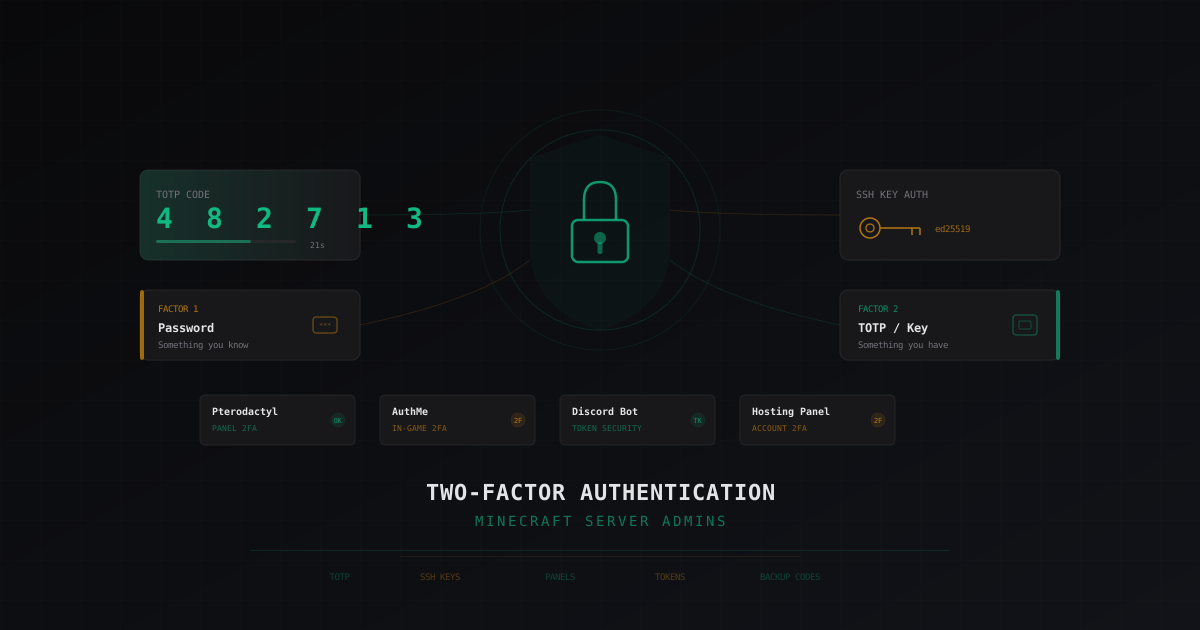
Two-Factor Authentication for Minecraft Server Admins: A Complete Guide
Why every Minecraft server admin needs 2FA, what happens when an admin account gets compromised, TOTP setup in AuthMe, panel access, and SSH. Protecting Discord bot tokens and backup codes.
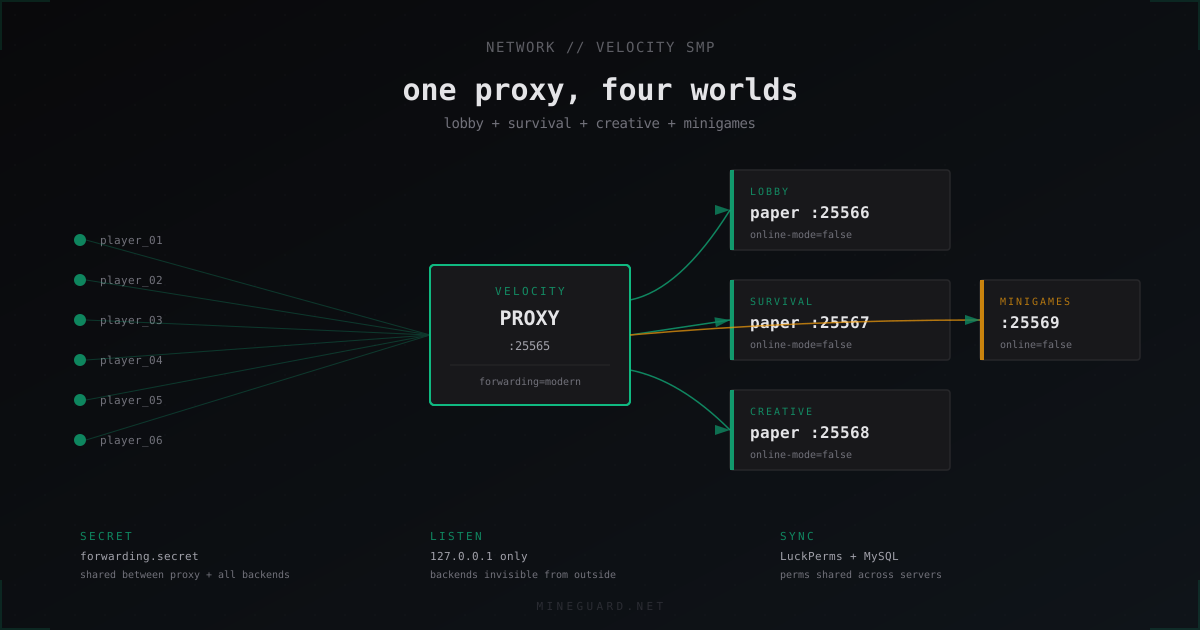
Velocity SMP network: lobby, survival, creative and minigames behind one proxy
How to build a multi-server SMP network on Velocity: velocity.toml setup, modern forwarding, syncing perms and chat between lobby, survival and creative.
Minecraft Server World Backup and Restore: Complete Guide
How to properly back up your Minecraft server world: manual and automated backups, remote storage, plugins, restore procedures, and protecting your data from loss.