Why MineGuard Web Captcha Cannot Be Auto-Solved by Bots
How bots attack Minecraft servers: captcha as the last line of defense
Bot attacks on Minecraft servers have become a real epidemic. Attackers use specialized software to connect hundreds or thousands of fake players to a server simultaneously. The goal is simple: overload the server, ruin the experience for real players, and cause maximum damage. At MineGuard, we see attacks daily where waves of 500-2000 bots hit a single server within minutes.
Many administrators install captcha as a way to tell real players from bots. The idea is correct, but implementing it through in-game plugins has a fundamental flaw. Let us explain why.
If you want to learn more about bot attacks and how to defend against them, we already covered this in a separate article on bot attacks. And the general principles of captcha protection are described in our captcha for Minecraft article.
Minecraft bot captcha: why in-game solutions fail
Chat-based text input plugins
The most common type of in-game captcha shows players a code in chat and asks them to type it back. For example, "Type 7X3K2 to continue." Sounds logical, but for a bot this is a trivial task. A Minecraft bot client receives all chat messages as plain text. The program parses the message, finds the code using a pattern, and sends it back. The entire process takes milliseconds.
Bot client developers added modules for auto-solving these captchas long ago. All you need is a regular expression to find the code in the message, and the bot passes the check faster than a real player.
Click-on-item or sign captcha
More advanced plugins place the player in a room with signs or items and ask them to click the correct one. This is harder to bypass, but still not a serious obstacle. The Minecraft protocol is fully open and documented. A bot can "see" all blocks around it, read text on signs, and simulate clicks at specific coordinates. Modern bot frameworks like Mineflayer provide convenient APIs for interacting with the game world.
Math problems and puzzles
Some plugins ask players to solve a math problem or answer a question. But any task that can be described as text in Minecraft chat can be solved by a program. Computers solve math far better than humans, and databases of answers to common questions take minutes to create.
The root problem with all in-game captchas is the same: the bot operates in the same environment as the plugin. The bot receives the same data and can send the same responses. There is no fundamental barrier between the bot and the verification.
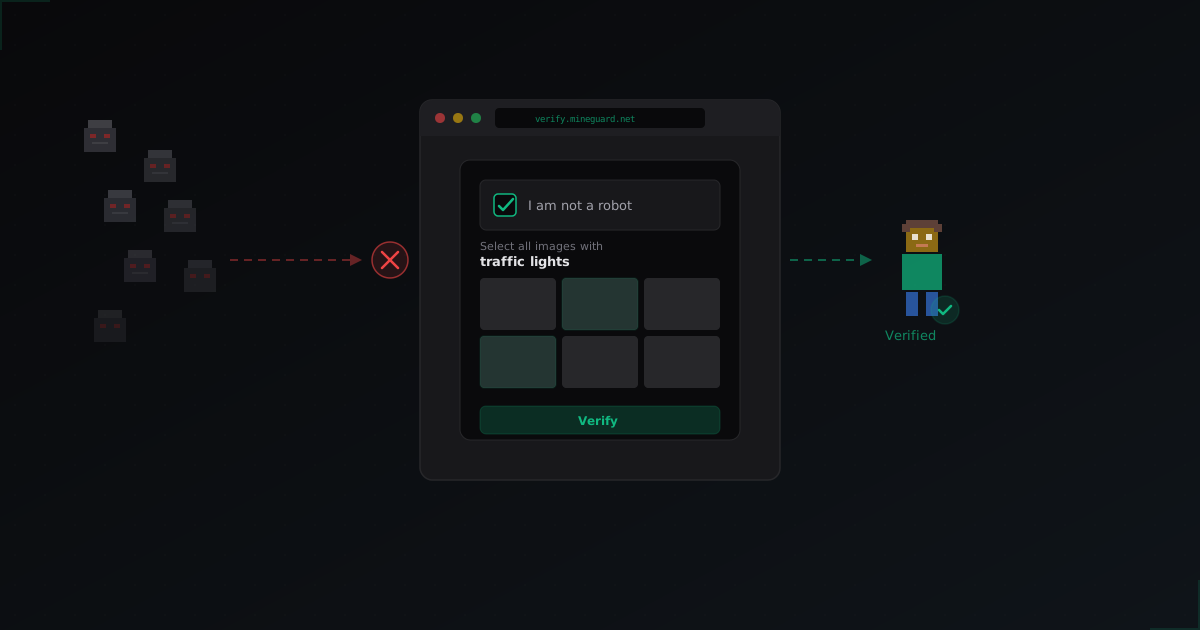
How MineGuard web captcha works
At MineGuard, we took a fundamentally different approach. Instead of verifying players inside Minecraft, we move the verification to a completely different environment: the web browser.
Here is how it works:
- A new player connects to a protected server through MineGuard
- Instead of entering the game normally, they receive a chat message with a unique link
- The player opens the link in a browser on their phone or computer
- In the browser, they complete a standard web captcha
- After successfully passing, the player automatically gains access to the server
This approach creates a barrier of an entirely different level. A Minecraft bot is a program that communicates using the Minecraft protocol. It knows how to connect to servers, send packets, and simulate player actions. But it is not a web browser. It has no HTML rendering engine, no JavaScript runtime, no ability to perform the complex tasks that modern captchas present to users.
Minecraft captcha bypass: why web captcha cannot be solved programmatically
The technological barrier
Modern web captchas use dozens of signals to determine whether a visitor is human. Mouse movement, keystroke patterns, reaction time, browser fingerprints, IP reputation, cookie history, and much more. To pass such a captcha automatically, you need to run a full browser in headless mode, but even that is detected by modern protection systems.
For a Minecraft bot, this means the following: in addition to the bot client itself, the attacker needs to run a browser instance in parallel for each bot. This drastically increases the complexity of the attack and resource consumption.
The economic barrier
Let us say the attacker decides to use services like 2captcha to have real humans solve captchas. The average cost of solving one captcha is about $0.003. Sounds cheap, but let us do the math.
A typical bot attack uses 500 to 2000 bots per wave. At $0.003 per captcha:
- 500 bots = $1.50 per wave
- 1000 bots = $3.00 per wave
- 2000 bots = $6.00 per wave
An attack usually consists of many waves. 10 waves of 1000 bots is already $30. A serious attack over the course of a day can cost hundreds of dollars. And that is just for captchas, not counting the cost of proxies and the bots themselves.
But the most important factor is time. Captcha solving services take 10 to 30 seconds per captcha. This means the attacker cannot send 1000 bots simultaneously. They will connect one by one with delays of tens of seconds. Instead of an instant wave, you get a slow trickle that is easily filtered by our rate limiting mechanisms.
The logistical barrier
Every captcha link in MineGuard is unique and tied to a specific connection. It has a limited lifetime and can only be used once. A bot cannot solve the captcha in advance or reuse a verification result for another connection. This makes it impossible to create a pool of "pre-solved" captchas.
Session management: we do not annoy real players
An important question: if the captcha is this strict, will it annoy regular players? No, and here is why.
MineGuard uses a session system. After a player passes the captcha once, they become verified. On subsequent connections, the system recognizes them and lets them through without another check. The captcha only appears for new, previously unknown connections.
For a regular player, the process takes 15-20 seconds on their first visit. After that, they play as usual. For a bot, every connection is a new problem that needs to be solved from scratch.
Layered defense: captcha as part of the system
The web captcha in MineGuard does not work in isolation. It is part of a comprehensive protection system that includes:
- Rate limiting to restrict connection frequency from a single IP
- VPN and proxy detection to block connections through anonymous networks
- IP firewall for automatic blocking of suspicious addresses
- Behavior analysis to detect unusual connection patterns
- XDP filtering to block packets at the kernel level before they reach the application
Each layer filters out a portion of bots. Only those that pass all previous checks reach the captcha. And the captcha serves as the final checkpoint, separating the last remaining bots from real players.
Availability: which plans include web captcha
Web captcha is available on our Optimal (2790 RUB/mo) and Professional (8600 RUB/mo) plans. If your server regularly faces bot attacks, this is an investment that pays for itself after the very first attack you deflect.
Bottom line: why bots lose
In-game captchas lose to bots because they operate in the same environment. It is like putting a lock on a door and handing the thief the key along with a lockpick. MineGuard web captcha moves the verification to an environment where bots have no tools. A Minecraft bot does not know how to open a browser, move a mouse across a page, and solve visual puzzles. And even if the attacker tries to use human labor to solve captchas, economics and time work against them.
We built a system where being a bot means losing. And we like it that way.
Protect Your Server from DDoS Attacks
Free protection with 5-minute setup. 1 TB bandwidth included.
Try for FreeRelated Articles
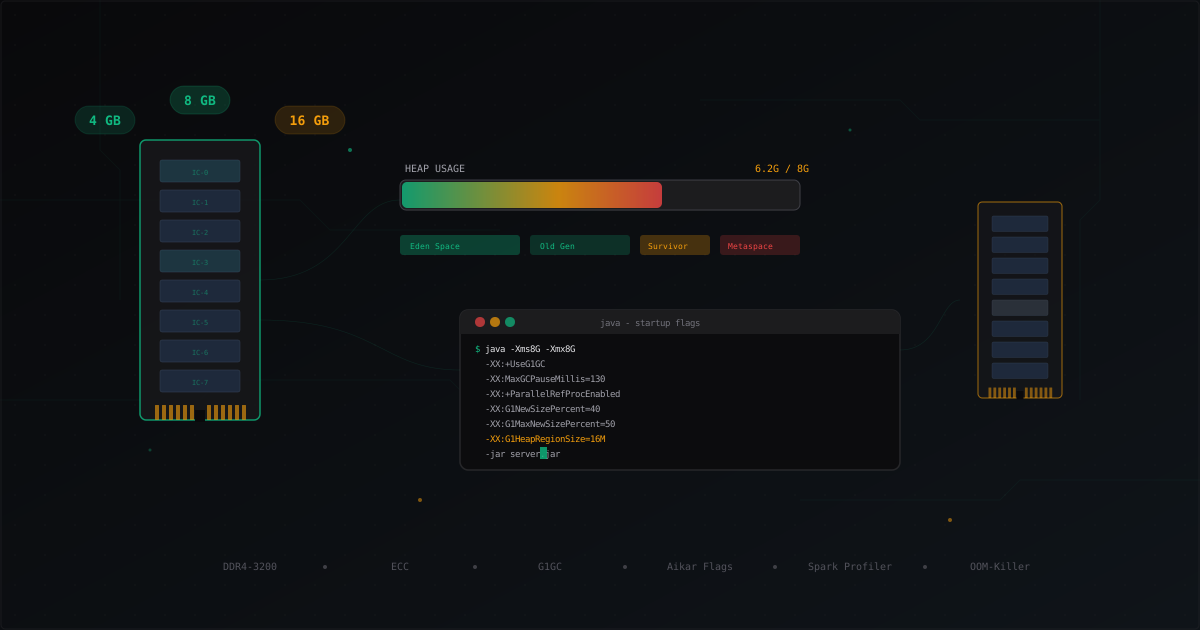
How Much RAM Does a Minecraft Server Need
A practical guide to choosing RAM for your Minecraft server: base requirements, per-player calculations, Paper vs Forge vs Fabric comparison, Aikar JVM flags, G1GC garbage collector tuning, and monitoring with spark.
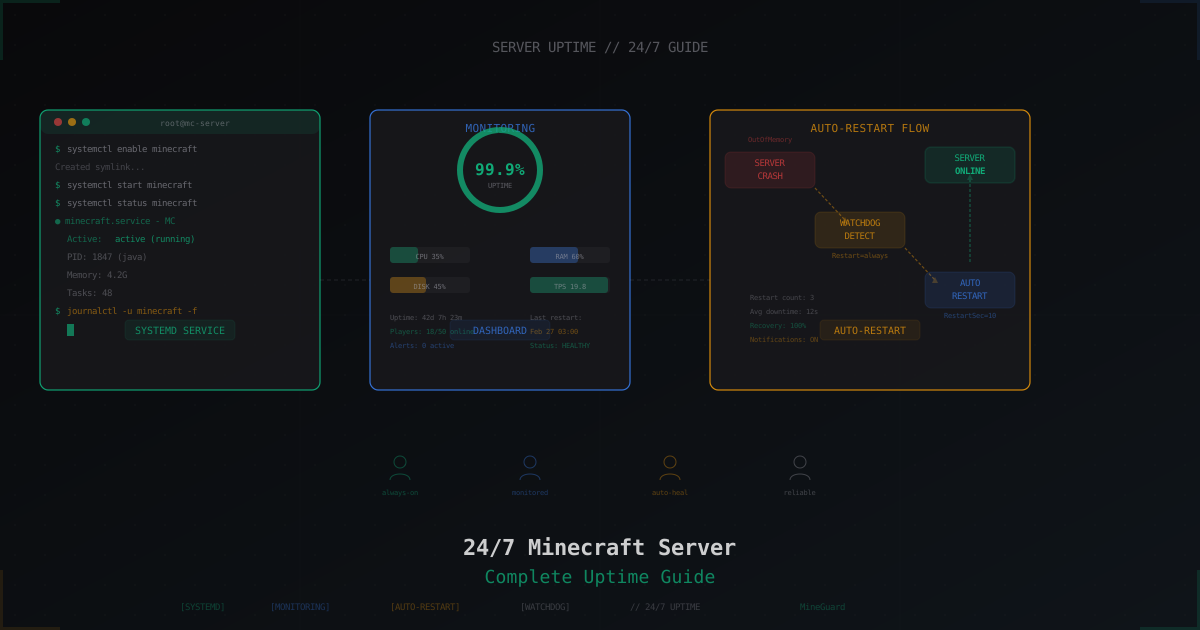
How to Keep a Minecraft Server Running 24/7
Step-by-step guide to running a Minecraft server 24/7: home PC vs VPS, screen/tmux setup, systemd services, auto-restart on crash, and DDoS protection.
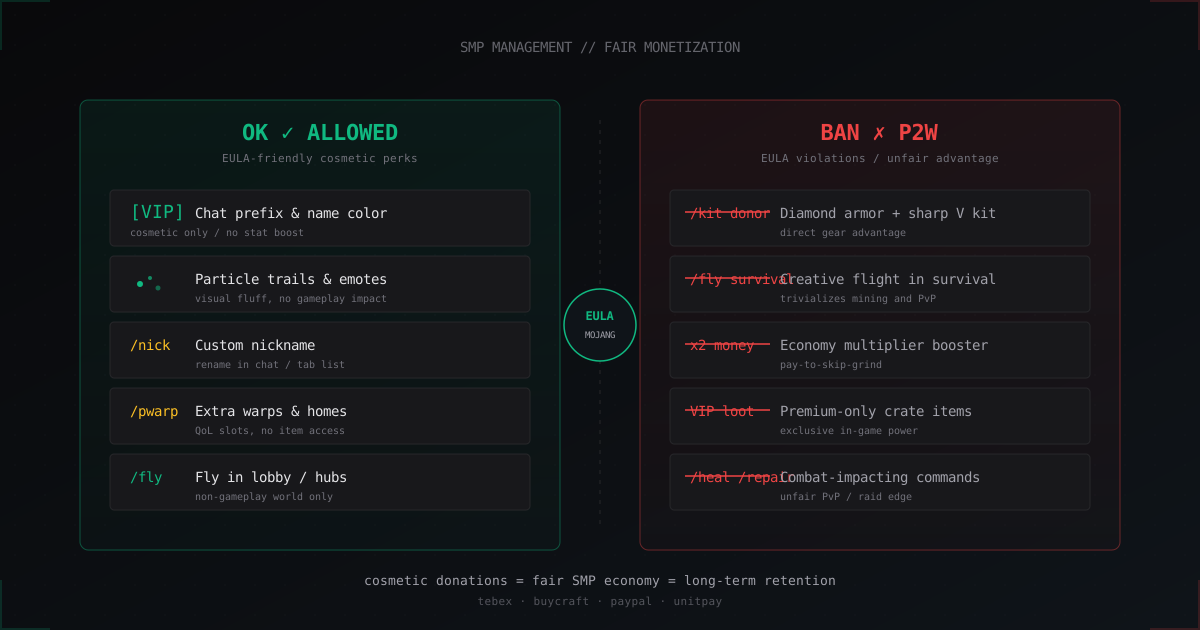
SMP Economy Without Pay-to-Win: Fair Monetization & EULA Guide
How to monetize an SMP without P2W: what EULA allows, what it forbids, ranks, Tebex, vote rewards, and realistic revenue numbers.