Layer 4 vs Layer 7 DDoS Attacks - What's the Difference
If you've ever looked into DDoS protection for your Minecraft server, you've probably come across the terms "Layer 4" and "Layer 7." Some services advertise L4 filtering, others tout L7 analysis. It sounds technical, but what does it actually mean for your server?
Let's break this down without the textbook fluff. What these layers are, what attacks target each one, and why proper protection needs both.
The OSI Model (Quick and Dirty)
OSI (Open Systems Interconnection) is a theoretical model that splits network communication into 7 layers. It was invented in the 80s for standardization, and it's still used as a shared language when people talk about networking.
Here are all 7 layers, bottom to top:
- Physical - wires, fiber optics, radio waves. Physical transmission of bits.
- Data Link - Ethernet frames, MAC addresses. Data transfer between adjacent nodes.
- Network - IP addresses, routing. How a packet finds its way from point A to point B.
- Transport - TCP and UDP. How data gets reliably (or quickly) delivered between applications.
- Session - session management. In practice, barely exists as a separate layer.
- Presentation - encoding, encryption. TLS lives roughly here.
- Application - HTTP, DNS, Minecraft protocol. What end-user applications actually work with.
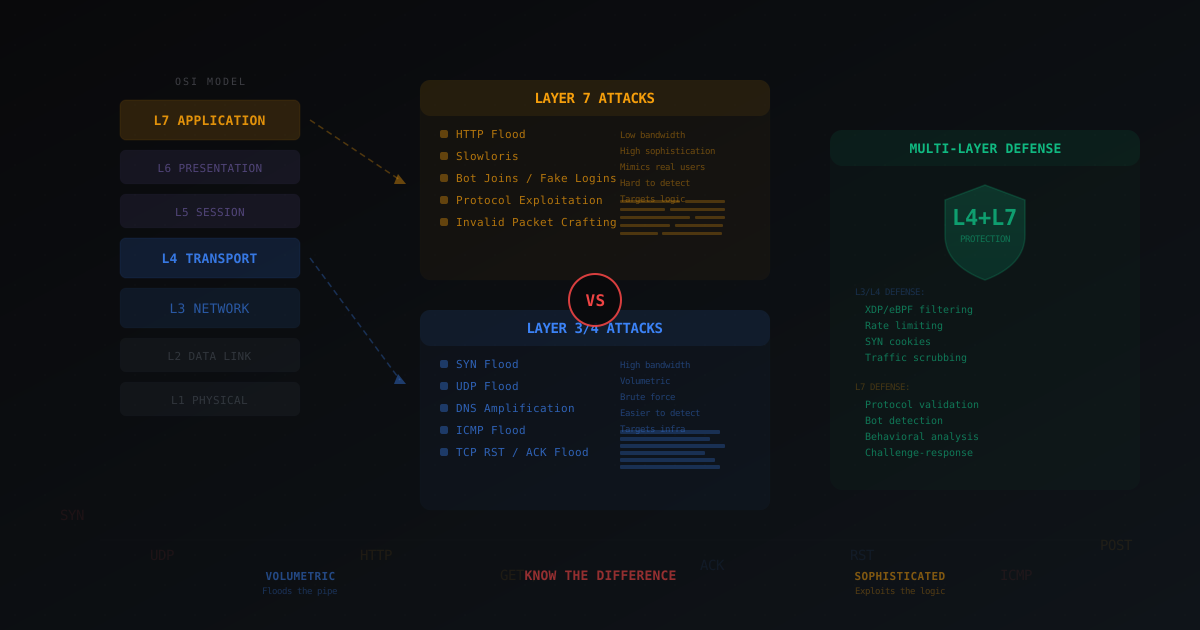
In practice, out of these 7 layers, three matter for DDoS attacks and defense: Layer 3 (Network), Layer 4 (Transport), and Layer 7 (Application). Layers 3 and 4 are usually grouped together as "L3/L4" or just "L4" because attacks at these levels are similar in nature - they deal with raw packets.
L3/L4 Attacks: Brute Force
Attacks on layers 3 and 4 are classic DDoS in its simplest form. The idea is dead simple: drown the server's bandwidth or resources with a massive amount of traffic. No cleverness needed - just volume.
SYN Flood
One of the oldest attacks, and still one of the most common. Here's how it works: when you connect to a server over TCP, there's a three-way handshake - SYN, SYN-ACK, ACK. In a SYN flood, the attacker sends thousands of SYN packets but never completes the handshake. The server allocates memory for each half-open connection and eventually chokes.
For Minecraft servers, SYN flood is particularly nasty because every new player connection starts with a TCP handshake. When the half-open connection table overflows, real players simply can't connect - the server can't process their SYN packets.
UDP Flood
UDP is a connectionless protocol. No handshake, no acknowledgments. Send a packet and you're done. This makes UDP a perfect vehicle for volumetric attacks: the attacker generates gigabytes of UDP traffic per second, saturating the server's inbound bandwidth.
Minecraft uses TCP for the main game traffic, but many servers also listen on UDP (query port, Voice Chat, plugins). Even if your server doesn't use UDP at all, the attack still clogs your pipe - packets arrive at the network interface and consume bandwidth before your firewall can drop them.
More on the differences between these protocols in our article about TCP vs UDP attacks.
Amplification Attacks
A clever variation of UDP flood. The attacker sends a small request to an intermediary server (DNS, NTP, memcached), spoofing the victim's IP address as the sender. The intermediary responds to the victim with a reply that's tens of times larger than the original request.
DNS amplification gives roughly a 50x amplification factor. Memcached - up to 51,000x. That means an attacker with a 100 Mbps connection can generate a 5 Gbps attack through DNS, or literally terabits through memcached.
ICMP Flood and Friends
ICMP flood (aka Ping flood), TCP RST flood, ACK flood - these are all variations on the same theme. Overwhelm the server or its pipe with packets of a particular type. They differ in implementation details, but the core idea is the same: volume, volume, volume.
Common Traits of L3/L4 Attacks
- Volumetric. Measured in Gbps (gigabits per second) or Mpps (millions of packets per second).
- Dumb (in a good way). No need to know anything about the application - just flood.
- Relatively easy to detect. Abnormal traffic spikes show up on graphs immediately.
- Target infrastructure. The goal is the pipe, network equipment, or the server's TCP stack.
L7 Attacks: The Smart Game
Layer 7 is the application layer. This is where HTTP, DNS, and - important for us - the Minecraft protocol live. L7 attacks are fundamentally different from L4: instead of brute force, they use finesse.
HTTP Flood
The classic L7 attack for web servers. The attacker sends thousands of fully valid HTTP requests. From a network perspective, this is legitimate traffic - proper TCP connections, correct HTTP headers. But each request forces the server to do work: query the database, render a page, burn CPU.
For Minecraft, this is less of a direct threat (your web panel and API aren't usually under that kind of pressure), but if you're running Dynmap, Plan, or another web panel on the same machine - an HTTP flood can overload it.
Slowloris
A beautiful attack named after the slow loris. The idea: open many HTTP connections and send data very slowly, preventing the server from closing the connection. Each connection occupies a slot on the server, and at some point legitimate users can't connect because all slots are taken by slow "zombie" connections.
This is an attack with minimal traffic. Literally kilobits per second. But the effect is devastating - the server becomes unreachable.
Bot Joins - Minecraft's L7 Nightmare
This is where things get really relevant for Minecraft server owners. A bot join is an L7 attack specific to the Minecraft protocol. The attacker launches thousands of fake clients that connect to the server, complete the handshake, sometimes even authenticate - and burn server resources doing it.
Each bot join forces the server to:
- Accept a TCP connection
- Process the Minecraft handshake
- Check the username against the auth system
- Possibly load chunks around spawn
- Allocate memory for the player entity
When there are thousands of bots, the server grinds to a halt. TPS drops to zero, real players lag out or get disconnected. And at the L4 level, everything looks perfectly normal - these are just regular TCP connections to port 25565.
Crafted Packets - Invalid Packet Attacks
Another type of L7 attack: sending specially constructed packets that technically conform to the Minecraft protocol structure but contain unexpected data. For example, overly long strings, negative values in fields that expect positive ones, or packets sent in the wrong order.
The goal is to trigger exceptions in the server code, provoke memory leaks, or simply force the server to waste CPU processing garbage. Some exploits of this type can straight-up crash a server with a single packet - if the code has an unhandled error path.
Protocol-Specific Attacks
The Minecraft protocol has its own quirks that attackers actively exploit:
- Status ping flood - mass requests for server status (motd, player count). Each request is legitimate, but in volume they overwhelm.
- Login flood - multiple login attempts that force the server to hit the Mojang API for verification.
- Chunk exploit - manipulation of chunk requests that force the server to generate and send massive amounts of data.
Common Traits of L7 Attacks
- Low traffic. Can operate at megabits or even kilobits per second.
- Mimicry. Look like legitimate traffic. Each individual request is indistinguishable from the real thing.
- Hard to detect. You can't just look at traffic volume - you need to analyze the content.
- Target application logic. The goal is CPU, memory, and specific weaknesses in the code.
- Require protocol knowledge. The attacker needs to understand how the target application works.
How Protection Differs at Each Layer
Different attacks require different defenses. L4 and L7 protection use fundamentally different approaches.
L3/L4 Protection
At this level, it's all about speed. Packets need to be analyzed and dropped before they reach the application. Key tools:
XDP/eBPF. Filtering at the network driver level, before the packet even enters the kernel's TCP/IP stack. This is the fastest filtering method - works at line rate, millions of packets per second. MineGuard uses this technology for L4 filtering.
SYN cookies. A mechanism that handles SYN packets without allocating memory. Instead of remembering every half-open connection, the server encodes the information in the sequence number. If the client is real and sends an ACK, the connection establishes. If not, zero resources wasted.
Rate limiting. Restricting the number of packets from a single IP or subnet. Simple but effective - if one IP is sending 100,000 packets per second, that's clearly not a legitimate player.
Blackhole / null-route. Last resort: all traffic to the attacked IP gets sent to a black hole. The attack stops, but the server becomes unreachable too. Used by providers when an attack threatens their other customers.
Traffic scrubbing. Traffic gets rerouted through a scrubbing center where bad packets are filtered out and good ones pass through to the server. Expensive, but handles attacks in the hundreds of gigabits.
L7 Protection
This requires a completely different approach. You can't just count packets - you need to understand what's inside.
Protocol validation. Checking that every packet conforms to the Minecraft protocol. Correct structure, valid field values, proper packet sequence. Invalid packets get dropped instantly.
Behavioral analysis. A real player behaves in a certain way: there are delays between actions, mouse movement isn't perfectly straight, their connection follows a characteristic pattern. A bot connects instantly, sends packets with machine precision, has no natural delay between actions. Good L7 protection recognizes the difference.
Challenge-response. Before letting a client through to the server, the protection asks a "question" - something a real client processes automatically, but a simple bot can't handle. For Minecraft, this might be a modified handshake or a data check during connection.
Bot detection. A combination of heuristics to determine if a connection is a bot: packet send rate, client version, connection behavior, IP reputation.
Connection throttling. Rate limiting with context awareness. Not just "no more than N connections per second," but "no more than N connections per second from clients exhibiting suspicious behavior."
Why You Need Both Layers
This is the key point that many people miss. Protection at only L4 or only L7 is like locking the front door but leaving the windows wide open.
L4 Only
You'll handle SYN floods and UDP floods just fine. Amplification? No problem. But when 5,000 bots connect to your server through completely legitimate TCP connections - your L4 filter won't even notice them. Each bot passed the handshake, sent a correct SYN, received a SYN-ACK, replied with ACK. Everything looks clean at the transport layer. Meanwhile, the server is dying because 5,000 fake Minecraft clients ate all its memory.
L7 Only
You'll block bot joins and invalid packets. But when 50 Gbps of UDP flood hits you, your L7 protection won't even see the traffic - it'll saturate your pipe before reaching your application. L7 analysis works with data inside packets, but if packets aren't getting through because the pipe is full - there's nothing to analyze.
The Right Approach: Multi-Layer Defense
Traffic first passes through the L3/L4 filter, which strips away volumetric attacks, garbage traffic, and packets from spoofed IPs. Whatever gets through the first filter hits the L7 analyzer, which inspects the content - protocol validity, client behavior, application-level rate limiting.
Think of it like an airport: first they check your passport (L4 - do you have the right to even enter), then they scan your baggage (L7 - what exactly are you carrying). Remove either check and security falls apart.
Real-World Gaming Examples
Example 1: Classic UDP Flood
Textbook scenario. A competing server orders a DDoS on a Minecraft project. The attack is pure UDP flood at 30-40 Gbps. The server's host sees the bandwidth spike and null-routes the IP. Server goes offline for an hour or two while the owner deals with the hosting provider. Solution: L4 protection through a proxy with sufficient bandwidth capacity. Traffic passes through the filter, UDP garbage gets stripped, legitimate Minecraft TCP traffic reaches the server.
Example 2: Bot Join Attack
A server with solid L4 protection. UDP and SYN floods get filtered. But the attacker switches to bot joins: 3,000 fake Minecraft clients connect simultaneously. Each one passes the TCP handshake (L4 filter lets them through - the connection is legitimate), sends a Minecraft handshake packet, and begins the login process. The server tries to handle 3,000 concurrent logins, TPS drops to 1-2, players lag out and disconnect. Solution: L7 filter that analyzes the Minecraft handshake, identifies bots by behavior, and blocks them before they load the server.
Example 3: Combined Attack
The nastiest variant. The attacker simultaneously launches a 20 Gbps UDP flood (to stress the L4 filter), a SYN flood (to fill the connection table), and bot joins (to load the server at the application level). Each attack individually might not be critical, but together they create pressure at every layer. Without multi-layer protection, at least one vector breaks through.
Example 4: Crafted Packet Exploit
The attacker finds a specific vulnerability in a server plugin. They send one (!) specially crafted packet that triggers an infinite loop in the handler. Server crashes. No gigabits needed, no thousands of bots - just one packet, assembled the right way. L4 protection will let it through (it's a normal TCP data packet). Only L7 protocol validation can catch this - verifying that the packet content is correct and safe.
What to Look For When Choosing Protection
When selecting DDoS protection for a game server, ask these questions:
What's the L4 filtering capacity? Measured in Gbps and Mpps. For a small server, 10-20 Gbps is enough. For a serious project, you need 100+ Gbps. Look not only at peak capacity but also at guaranteed capacity.
Is there L7 analysis? Specifically for the Minecraft protocol. A generic WAF (Web Application Firewall) won't cut it - you need protection that understands the Minecraft protocol.
What's the latency? Filtering adds latency. For games, this is critical. Good protection adds 1-5 ms. Bad protection adds 20-50 ms. The difference is enormous for PvP.
How are false positives handled? If the protection blocks real players, that's worse than having no protection at all. Ask about the false positive rate.
Can it handle combined attacks? How does the system cope when L4 and L7 attacks come simultaneously?
The Bottom Line
Layer 4 and Layer 7 aren't two flavors of the same thing. They're different categories of attacks that operate on different principles and require different defense methods.
L3/L4 attacks are brute force. Gigabits of traffic, millions of packets. Defense works at the network level: packet filtering, rate limiting, XDP/eBPF.
L7 attacks are precision weapons. Low traffic, but each request hits application logic. Defense works at the protocol level: validation, behavioral analysis, challenge-response.
For proper Minecraft server protection, you need both layers. Not "either-or" but "both-and." L4 strips away the garbage, L7 filters what got through the first layer and tries to attack at the application level.
If your current protection only covers one of these layers - you're only half protected. And attackers know it.
Protect Your Server from DDoS Attacks
Free protection with 5-minute setup. 1 TB bandwidth included.
Try for FreeRelated Articles
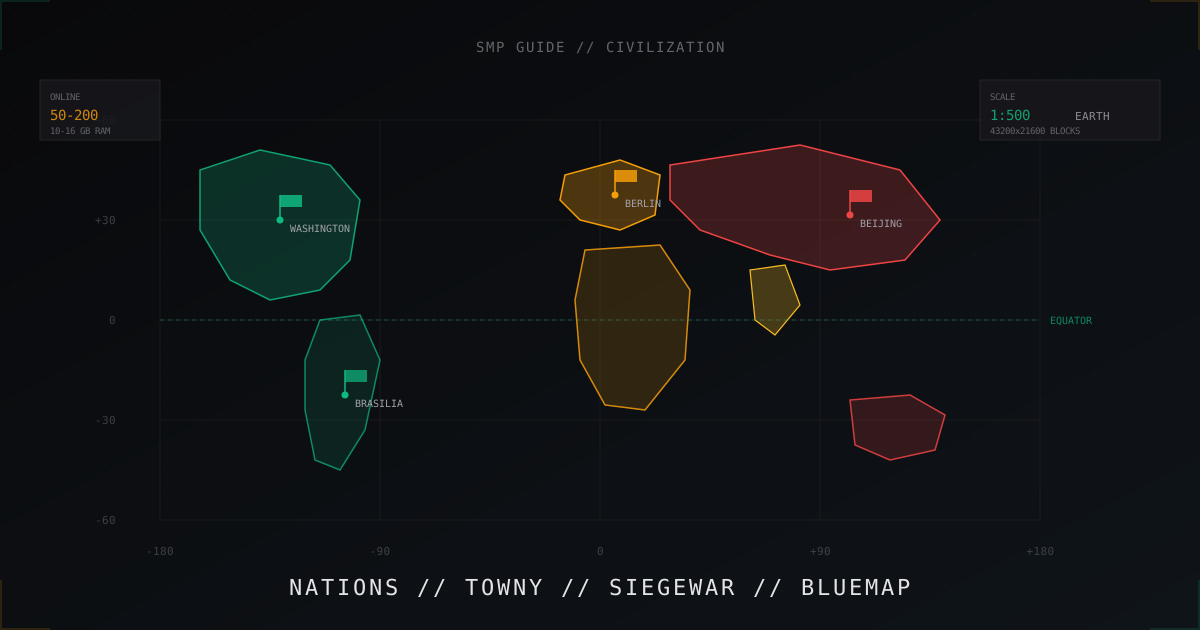
Civilization SMP from scratch: building an EarthMC-style nations server
Earth map, nations, city sieges and BlueMap. Full guide to building a civ SMP server in EarthMC style: plugins, economy, wars.
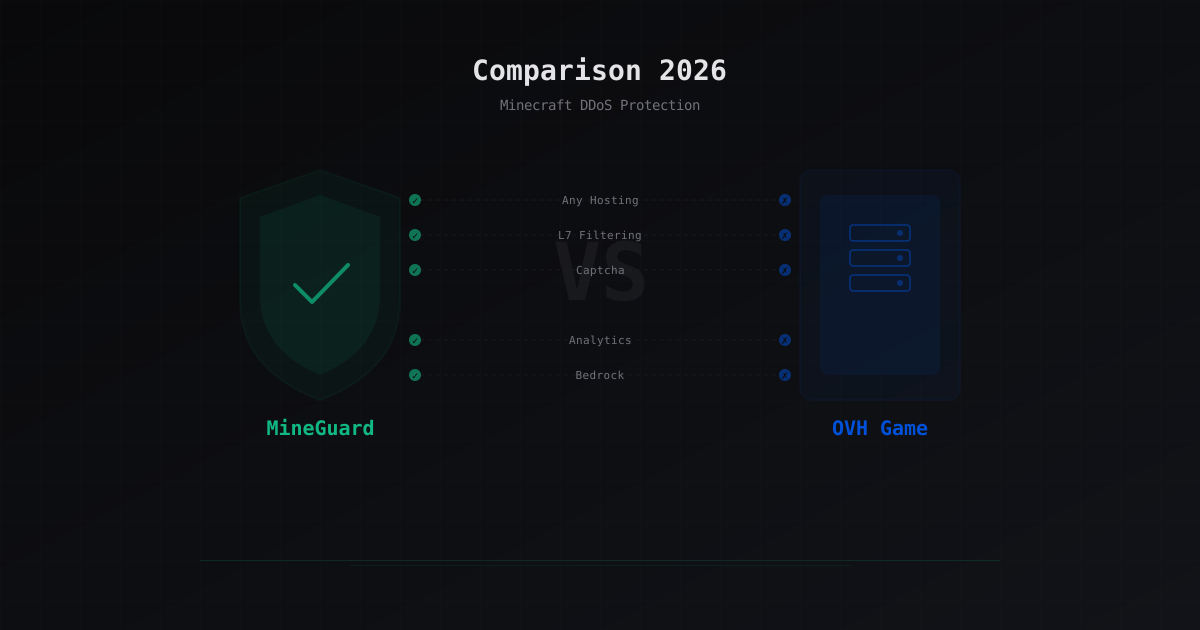
MineGuard vs OVH Game DDoS Protection: Which Is Better for Minecraft
I compare MineGuard and OVH Game DDoS Protection for Minecraft servers. Breaking down differences in approach, L7 attack filtering, captcha capabilities, analytics, and hosting lock-in. Honest comparison with feature table.
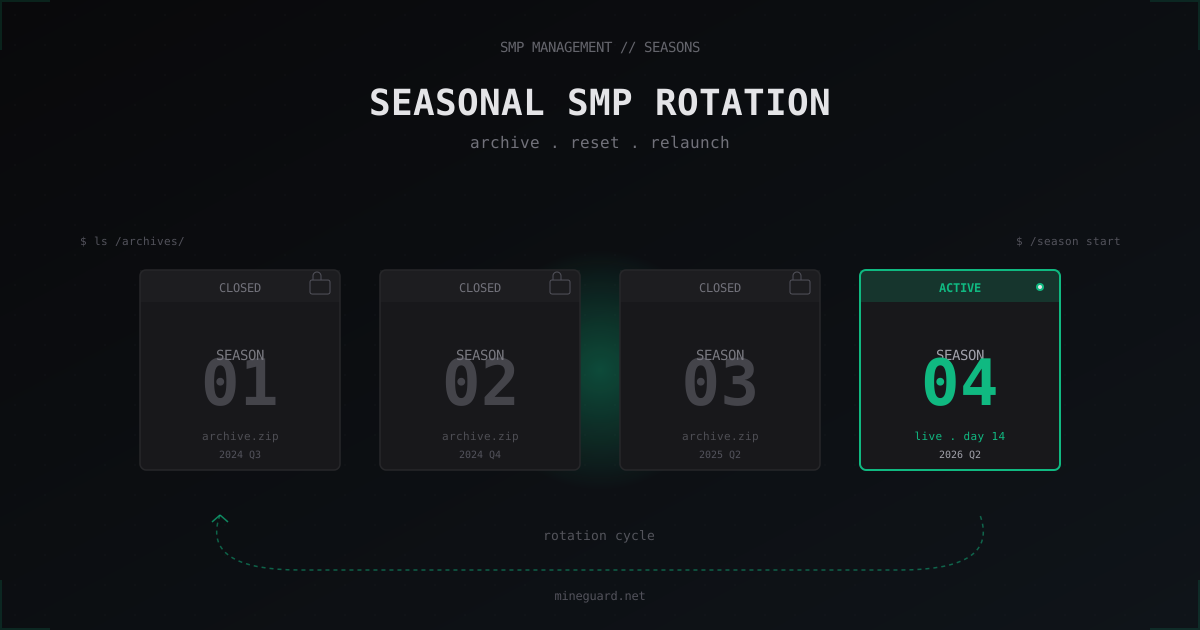
Seasonal SMP: How to Run Season Rotations on Your Minecraft Server
Season length, what carries over, how to archive worlds and launch the next SMP without losing your community. With commands and Chunky pre-gen.