How Captcha Protects Minecraft Servers from Bots
If you have ever run a public Minecraft server, you have almost certainly dealt with bot attacks. Dozens, hundreds, sometimes thousands of fake players connect simultaneously, overwhelming server resources. Chat fills with spam, real players cannot join, and TPS drops to unplayable levels. This is not just an inconvenience. It is a real threat that can kill your community.
What Bot Attacks Look Like
Modern Minecraft bots can mimic a real player connection convincingly. They complete the handshake with the server, send well-formed packets, and can even perform basic in-game actions. Some attacks use stolen accounts, while others connect through offline mode on cracked servers. The result is the same: the server wastes resources processing fake connections.
Common attack scenarios include:
- Connection flooding - hundreds of bots attempt to join the server at once
- Chat spam - bots send advertisements or abusive messages
- World load attacks - bots load chunks and strain world generation
- Crash attacks - specially crafted packets designed to trigger server errors
Why Standard Solutions Fall Short
The first thought is usually: just add Google reCAPTCHA and call it a day. In practice, it is not that simple.
Google reCAPTCHA works well on regular websites, but it has several issues in the Minecraft context:
Regional restrictions. Many players connect from regions where Google services load slowly or are blocked entirely. For them, completing a reCAPTCHA becomes an endless wait for scripts to load.
Loading speed. reCAPTCHA loads fairly heavy scripts. For a player who wants to quickly join a server and start playing, waiting 5 to 10 seconds for a captcha to load is not a great experience.
User experience. Standard captchas asking you to find traffic lights and crosswalks look out of place in a Minecraft context. Players expect something related to the game, not corporate website forms.
Third-party dependency. If Google servers experience issues, your verification stops working too. You lose control over a critical part of your protection.
How Web Captcha Works for Minecraft
The concept is straightforward: before a player gets onto the server, they complete a quick verification in their browser. Here is how it works in practice:
- A player connects to the server
- The system determines this player has not passed verification yet
- A verification link appears in chat
- The player opens the link in their browser and completes the challenge
- After successful verification, the player is automatically connected to the server
The entire process takes a few seconds. For a real player, it is a minimal inconvenience. For a bot, it is an insurmountable barrier because bots cannot open a browser and complete a visual challenge.
Verification Types
Several captcha types exist, each with its own approach:
Slider (drag the element)
The player needs to drag an element to the correct position. This is a fast and intuitive verification method that requires minimal effort. Just click, drag, and done.
Item Selection
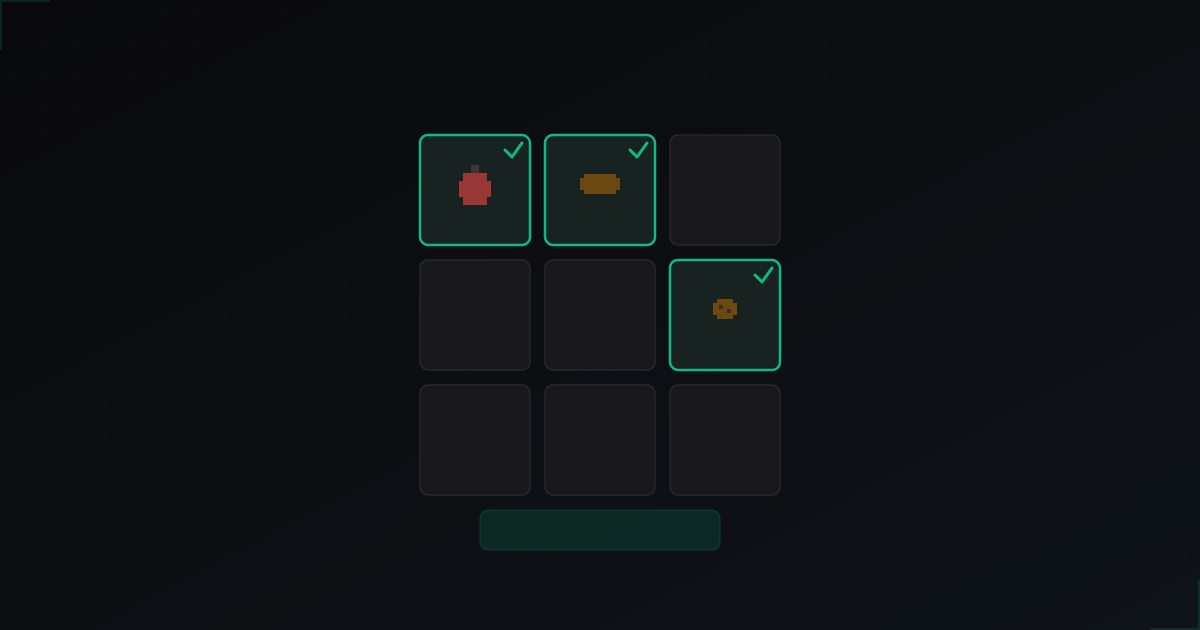
Several Minecraft items appear on screen, and the player needs to pick the correct one. For example, finding a diamond sword among other items. For anyone familiar with the game, this is trivial. For a bot, it requires image recognition capabilities.
Image Rotation
The player sees a rotated image and needs to return it to the correct orientation. This type of verification works well because the exact rotation angle is difficult to guess programmatically.
Find the Pair
A classic matching mechanic adapted to the Minecraft theme. The player needs to find identical elements among a set of cards. Simple but effective verification.
All these verification types share one thing: they are easy for humans and hard to automate. Each one uses Minecraft theming with familiar blocks, items, and textures. Players do not feel like they are being pulled away from the game. It feels more like a mini-game.
Benefits of Custom Minecraft Captcha
Compared to standard solutions, a specialized Minecraft captcha offers several important advantages:
Works everywhere. No dependency on external services. The verification page loads from your own server, so there are no regional blocking issues.
Fast loading. A lightweight page without heavy external scripts. Players see the challenge almost instantly.
Themed design. The captcha looks like part of Minecraft. You can customize colors, add your server logo, and set a background. Players perceive it as part of the game experience rather than an obstacle.
Full control. You decide which verification types to use, how often to check players, and what exceptions to make. No dependency on a third-party provider's policies.
Multiple verification types. The ability to rotate different captcha types makes automated bypassing significantly harder. A bot that learns to bypass one type of challenge will face a different one next time.
Things to Consider
Captcha is not a silver bullet. Here are a few important points:
- Balance security and convenience. A captcha that is too hard will drive away real players. One that is too easy will not stop advanced bots. You need to find the right balance.
- **
- Re-verification. Do not force players to complete captcha every time. Verification should be remembered for a reasonable period.
Conclusion
Bot attacks are a reality for any public Minecraft server. Web captcha with Minecraft theming is a practical way to filter bots without ruining the experience for real players. It is fast, works without external dependencies, and integrates easily with existing server infrastructure.
The key is finding the right balance: the verification needs to be hard enough for bots while remaining quick and easy for players. With a properly configured verification system, your server will be protected from the vast majority of automated attacks.
Protect Your Server from DDoS Attacks
Free protection with 5-minute setup. 1 TB bandwidth included.
Try for FreeRelated Articles
DDoS Attack Trends for Minecraft Servers in 2026
Breaking down the top DDoS attack trends for Minecraft servers in 2025-2026: growing volumes, new attack vectors, smart botnets, and how to defend against it all.
CoreProtect: Rollback Grief and Investigate Incidents on Your Minecraft Server
How to install CoreProtect, find the griefer via /co lookup, and undo the damage with /co rollback without restoring a world backup.

TCP vs UDP Attacks on Minecraft Servers: Breaking Down the Differences
Minecraft Java runs on TCP, Bedrock on UDP. Attacks on these protocols differ fundamentally: SYN floods vs amplification, stateful filtering vs DPI. We break down each attack type, real traffic volumes, and defense strategies.